The “bad and boujee meaning” is one of those phrases that exploded into mainstream culture so fast that many people started using it without fully understanding what they were saying. If you have heard it in a song, seen it in a meme, or had a friend call themselves “boujee” and felt a little lost, you are not alone. This article breaks down exactly what the phrase means, where it came from, how the words work separately and together, and how to use it without sounding out of touch.
Quick Answer: “Bad and boujee” combines “bad” (slang for attractive, confident, or impressive) with “boujee” (a shortened form of “bourgeois,” meaning someone who acts rich, classy, or high-maintenance). Together it describes a person, usually a woman, who is both physically attractive and has expensive, luxurious, or high-class tastes.
What Does “Bad” Mean in This Context?
In standard English, “bad” means the opposite of good. But in African American Vernacular English (AAVE) and broader hip hop culture, “bad” has carried a positive meaning for decades. When someone says a woman is “bad,” they mean she is extremely attractive, stylish, confident, and desirable. It is a compliment of the highest order in that context.
This usage goes back to at least the 1970s and 1980s. Michael Jackson’s 1987 album was literally titled “Bad,” and the title track included the lyric “I’m bad, you know it,” where “bad” clearly meant impressive, tough, and cool rather than morally wrong. The word had already been used this way in Black communities for years before that.
So when you hear “bad” in “bad and boujee,” it has nothing to do with being naughty or misbehaving. It is about being visually stunning and having a magnetic presence. Think of it as the opposite of “basic.” A “bad” person turns heads when they walk into a room.
Pro Tip: Context matters enormously here. If someone says “she’s bad” with a certain tone and in a casual or admiring context, it is almost always a compliment. The same word in a formal setting or with a different tone means something entirely different.

What Does “Boujee” Mean?
“Boujee” (also spelled “bougie” or “bourgie”) is a shortened, slang version of the French word “bourgeois.” The term “bourgeoisie” originally referred to the middle class in Marxist theory, but in everyday usage it evolved to describe people with materialistic, upper-class aspirations. When someone is called “boujee” in modern slang, it means they like expensive things, prefer luxury brands, enjoy upscale dining and travel, and generally act like they have money (whether or not they actually do).
The word “bougie” existed in Black American slang well before the Migos song. It was often used as a mild insult or teasing term for someone who acted “too good” for their roots, someone who put on airs, or someone who had pretentious tastes. A person who refuses to eat at a regular diner and insists on a fancy brunch spot with bottomless mimosas might be called “bougie.”
The spelling “boujee” gained popularity specifically because of the Migos song, which we will get to in a moment. The double-e spelling gave it a distinct visual identity and separated it slightly from the older, sometimes negative connotation of “bougie.”
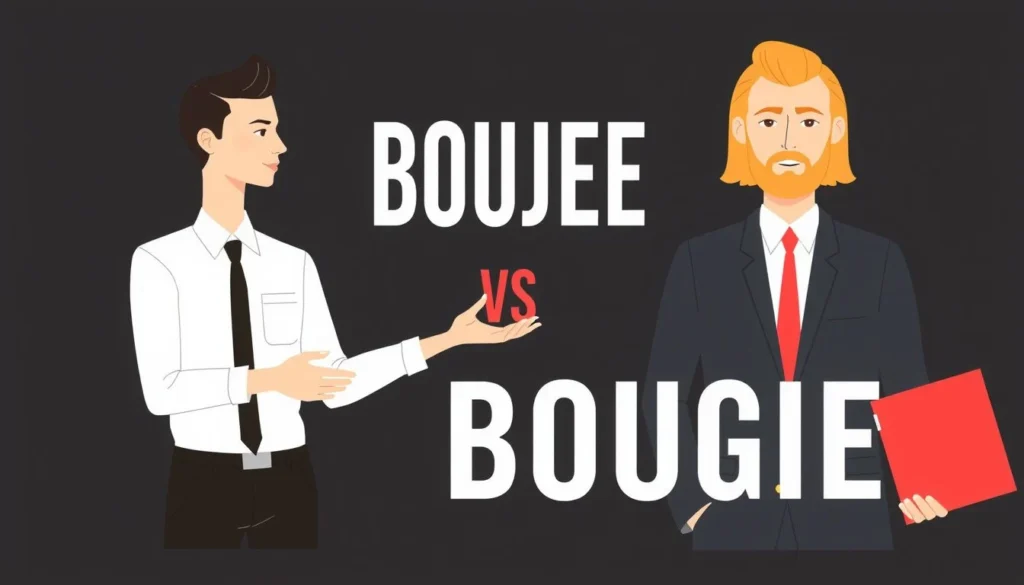
Here is a quick comparison of the two spellings and their subtle differences:
| Aspect | Bougie | Boujee |
|---|---|---|
| Origin | Older slang, used since at least the 1980s | Popularized by Migos in 2016 |
| Connotation | Often slightly negative, implying pretentiousness or being “too good” | More playful and aspirational, sometimes positive |
| Common Usage | “She’s so bougie, she won’t drink tap water” | “She’s bad and boujee, always in designer” |
| Tone | Teasing or critical | Admiring or self-descriptive |
The distinction is not rigid. Many people use both spellings interchangeably. But if you want to be precise, “bougie” leans more toward the critical side and “boujee” leans more toward the aspirational, glamorous side.
Pro Tip: If you are writing about this phrase in a professional context, use “bougie” for the older, more established spelling. Use “boujee” when specifically referencing the Migos song or the modern meme culture around it.
The Migos Song That Started It All
You cannot explain the “bad and boujee meaning” without talking about the song itself. “Bad and Boujee” is a track by the Atlanta hip hop trio Migos, featuring Lil Uzi Vert. It was released in August 2016 as part of Migos’ album “Culture,” though it gained massive popularity in late 2016 and early 2017.
The song’s chorus, delivered by Quavo, goes:
“Rain drop, drop top / Smokin’ on cookie in the hotbox / Cookie cookie, look at my wrist / It’s a wet wrist, don’t look at my wrist / My bitch is bad and boujee / Cookin’ up dope with a Uzi”
The line “my bitch is bad and boujee” is the core of the phrase’s popularity. In the context of the song, the rapper is describing his romantic partner as both physically stunning (“bad”) and having expensive, high-class tastes (“boujee”). She is the complete package: beautiful and glamorous.
The song hit number one on the Billboard Hot 100 in January 2017, which was a major milestone for Migos. It became their first number one single and one of the defining songs of the trap music era. The phrase “bad and boujee” quickly escaped the song and became a cultural shorthand.
One notable moment that boosted the phrase’s popularity was when actor Donald Glover, accepting a Golden Globe award in January 2017 for his show “Atlanta,” thanked Migos and said “I really want to thank the Migos, not for being in the show, but for making ‘Bad and Boujee.'” That moment introduced the phrase to an even wider audience, including many people who had never listened to trap music.
The song’s success also sparked a wave of memes. People started captioning photos of themselves in fancy outfits, expensive meals, or luxury settings with “bad and boujee.” The phrase became a way to signal that you have expensive taste and look good while doing it.
How “Bad and Boujee” Is Used Today
The phrase has evolved beyond the song. Today, people use “bad and boujee” in several distinct ways:
- As a compliment: Calling someone “bad and boujee” is a high compliment. It means they are attractive and have great taste. It is often used between friends or romantic partners.
- As self-description: Many women (and some men) describe themselves as “bad and boujee” on social media, particularly on Instagram and TikTok. It is a way of asserting confidence and a luxurious lifestyle.
- As a hashtag: #badandboujee has millions of posts across social platforms. People use it for outfit photos, makeup looks, travel shots, and expensive meals.
- As a title for events: The phrase has been used for parties, brunches, and themed events. A “Bad and Boujee Brunch” typically means an upscale brunch with a dress code and a glamorous vibe.
- As a general descriptor for aesthetics: Sometimes the phrase describes things rather than people. A restaurant, a hotel, or a fashion collection might be called “bad and boujee” if it is both impressive and luxurious.
Pro Tip: If you are using the phrase in a social media caption or casual conversation, make sure the context matches the vibe. Calling a cheap fast food meal “bad and boujee” as a joke can work ironically, but using it seriously for something that is not actually impressive or luxurious will come across as clueless.
Is “Bad and Boujee” Offensive or Problematic?
This is a fair question, and it deserves a nuanced answer. The phrase itself is not inherently offensive. It originated in Black culture, specifically in AAVE and hip hop, and it has been widely adopted across racial and cultural lines. However, there are a few things worth considering.
The word “boujee” has roots in class criticism. When used negatively, it can imply that someone is fake, pretentious, or trying too hard to appear wealthy. In the Migos song, the connotation is mostly positive, but the older usage of “bougie” as an insult still exists. If you call someone “bougie” with a certain tone, you are criticizing them for being snobbish or out of touch.
There is also the question of cultural appropriation. “Bad and boujee” comes from AAVE, and like many AAVE terms, it has been adopted by non-Black speakers, sometimes without understanding or acknowledging its origins. This is not a reason to avoid the phrase entirely, but it is worth being aware of where the language comes from and using it respectfully.
A good rule of thumb: if you are using the phrase to describe yourself or someone else in a positive, playful way, you are probably fine. If you are using it to mock or stereotype, that is a problem.
How to Use “Bad and Boujee” Correctly
If you want to use the phrase without sounding awkward, here are some practical guidelines:
- Use it for people, not objects, in most cases. The phrase originally describes a person. You can extend it to aesthetics, but it lands best when applied to a human being.
- Match the tone. “Bad and boujee” is casual and playful. It does not belong in a formal email or a job interview.
- Understand the compliment. If someone calls you “bad and boujee,” say thank you. It is a genuine compliment.
- Do not overuse it. Like any slang, the phrase loses its punch if you use it constantly. Save it for moments that actually fit.
- Know the spelling difference. If you are referencing the Migos song specifically, use “boujee.” If you are using the older slang term, “bougie” is more established.
Key Takeaways
- “Bad and boujee” means attractive and luxurious. “Bad” is slang for stunning or impressive, and “boujee” means having expensive, high-class tastes.
- The phrase was popularized by Migos. Their 2016 song “Bad and Boujee” featuring Lil Uzi Vert took the phrase from regional slang to global mainstream.
- “Boujee” and “bougie” are related but slightly different. “Bougie” is the older term and often carries a more critical tone, while “boujee” is more playful and aspirational.
- The phrase has roots in AAVE and hip hop culture. It is a compliment, not an insult, when used in its modern context.
- Use it casually and positively. It works best in social media captions, casual conversation, and playful self-description, not in formal writing.
Frequently Asked Questions About “Bad and Boujee Meaning”
Q: What does “bad and boujee” literally mean?
A: Literally, it combines “bad” (slang for extremely attractive or impressive) with “boujee” (slang for bourgeois, meaning having expensive or high-class tastes). Together it describes someone who is both physically stunning and glamorous or luxurious in their lifestyle.
Q: Is “boujee” the same as “bougie”?
A: They are closely related and often used interchangeably, but there is a subtle difference. “Bougie” is the older spelling and often carries a slightly negative connotation of being pretentious or snobbish. “Boujee” was popularized by the Migos song and tends to have a more positive, aspirational, playful tone.
Q: Where did the phrase “bad and boujee” come from?
A: The phrase gained mainstream popularity from the Migos song “Bad and Boujee,” released in 2016 and featuring Lil Uzi Vert. The song hit number one on the Billboard Hot 100 in January 2017. However, both “bad” and “bougie” as slang terms existed in Black American culture long before the song.
Q: Is calling someone “bad and boujee” a compliment?
A: Yes. In modern usage, calling someone “bad and boujee” is a compliment. It means they are attractive, confident, and have expensive or refined taste. It is often used between friends or as a term of admiration.
Q: Can a man be “bad and boujee”?
A: The phrase is most commonly used to describe women, and that is how it appears in the Migos song. However, there is no hard rule against using it for men. A man with great style and expensive taste could be described as “bad and boujee,” though it is less common.
Q: What does “boujee” mean on TikTok?
A: On TikTok, “boujee” is used to describe anything that looks expensive, luxurious, or high-end. People use it in captions and comments for videos showing luxury fashion, fancy restaurants, first-class travel, or elaborate home decor. It is often used playfully and sometimes ironically.
Q: Is “bad and boujee” from AAVE?
A: Yes. Both “bad” (meaning good or attractive) and “bougie” or “boujee” (meaning bourgeois or high-class) have roots in African American Vernacular English. The phrase was popularized by Black artists and has since entered mainstream English.
Q: What is the difference between “bad” and “boujee” as separate words?
A: “Bad” refers to physical attractiveness, confidence, and overall impressive presence. “Boujee” refers to taste, lifestyle, and affinity for luxury. A person can be “bad” without being “boujee” (attractive but low-maintenance) or “boujee” without being “bad” (luxurious taste but not conventionally stunning). The phrase combines both qualities.
Q: How do you pronounce “boujee”?
A: It is pronounced “BOO-jee,” with the first syllable rhyming with “too” and the second syllable sounding like the letter “G.” The emphasis is on the first syllable.
Q: Is “bad and boujee” still relevant in 2024 and beyond?
A: The phrase peaked in popularity around 2017, but it has not disappeared. It remains a recognizable cultural reference and is still used on social media, in fashion contexts, and in casual conversation. It has become a lasting piece of 2010s slang rather than a fleeting trend.
References & Further Reading
- Migos’ “Bad and Boujee” on Billboard, Chart history and song details from Billboard, the authoritative source for music chart data.
- Merriam-Webster on “Bougie”, Dictionary definition and etymology of “bougie” and its slang usage.
- Dictionary.com on “Boujee”, A detailed breakdown of the slang term “boujee,” its origins, and examples of usage.
- NPR on Donald Glover’s Golden Globes Speech, Coverage of the moment that helped propel “Bad and Boujee” into mainstream consciousness.
—
About This Article: This article was researched and written by a content strategist with a background in linguistics and popular culture analysis. The goal was to provide a clear, accurate, and context-rich explanation of the phrase “bad and boujee” that respects its cultural origins while making the meaning accessible to anyone who encounters it. Sources were checked for accuracy at the time of publication.

Pingback: Define Boujee Meaning: What It Really Means and How to…