The boujee meaning slang question comes up a lot, especially if you’ve heard the word in a song or seen it in a meme and weren’t quite sure what people were getting at. Here’s the short version: boujee describes someone or something that acts rich, fancy, or high-class, but usually with a playful or slightly mocking undertone. It’s not just about having money. It’s about performing wealth in a very specific, often exaggerated way.
Quick Answer: Boujee (also spelled bougie or boughetto) is slang for acting wealthy, upper-class, or fancy, often in a way that’s seen as trying too hard or being “extra.” It comes from the word “bourgeoisie” and is usually used playfully, not as a serious insult.
By the end of this article, you’ll know exactly what boujee means, where it came from, how it’s different from similar words like “bougie,” and how to use it in a sentence without sounding out of touch.
What Does Boujee Mean in Slang?
At its core, boujee is an adjective. You use it to describe a person, a place, a thing, or even a behavior that screams “I have expensive taste” or “I’m too good for this.” Think designer bags, refusing to drink tap water, or insisting on valet parking at a strip mall.
The key to understanding boujee meaning slang is recognizing the tone. It’s rarely a neutral description. There’s almost always a wink involved. When someone calls you boujee, they’re saying: “Okay, look at you with your fancy stuff.” It can be affectionate, teasing, or mildly critical, depending on the context and your relationship with the person saying it.
Here’s a quick breakdown of the different flavors of boujee:
- The Playful Tease: Your friend orders a $14 avocado toast and calls it “a simple breakfast.” You say, “Okay, boujee.”
- The Self-Deprecating Joke: You buy a fancy candle for your studio apartment and caption your photo “feeling boujee today.”
- The Mild Criticism: Someone refuses to eat at a chain restaurant because it’s “beneath them.” A bystander might mutter, “That’s so boujee.”
- The Genuine Observation: A person genuinely lives a luxurious lifestyle. You might describe their penthouse as “boujee as hell.”
The word has a lot of range, which is part of why it stuck around.
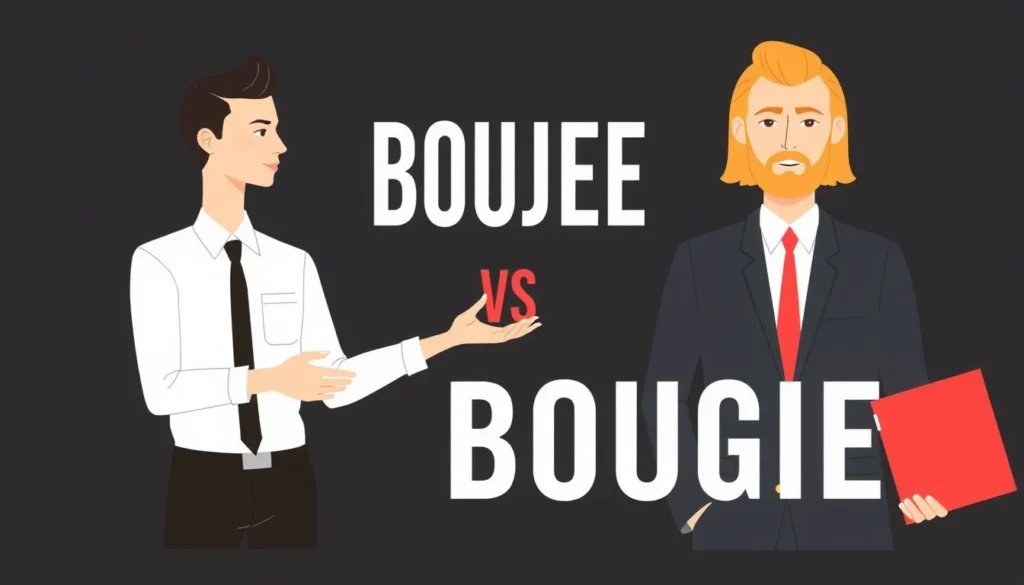
Boujee vs. Bougie: Is There a Difference?
You’ll see both spellings online, and people argue about this. The short answer is: they mean the same thing. “Bougie” is the more traditional spelling, derived directly from “bourgeoisie.” “Boujee” is a more modern, phonetic spelling that gained massive popularity through hip-hop culture.
The difference is mostly about vibe. “Bougie” can feel a little more academic or old-fashioned. “Boujee” feels more playful, more musical, more connected to the specific way the word was used in rap songs. When most people search for boujee meaning slang, they’re thinking of the “boujee” spelling because that’s the one that blew up in popular culture.
Pro Tip: Use “boujee” in casual conversation and social media. Use “bougie” if you’re writing something slightly more formal or if you want to emphasize the word’s French roots. Both are correct, and nobody reasonable will correct you.

Where Did Boujee Come From?
The word has a surprisingly long history. It starts with the French word “bourgeoisie,” which refers to the middle class, specifically the class that owns property and capital. Karl Marx used the term a lot to describe the capitalist class in contrast to the working class (the proletariat).
Over time, “bourgeois” became shorthand for conventional, materialistic, middle-class values. To be “bourgeois” meant you cared about keeping up appearances, owning nice things, and fitting into respectable society.
The slang form “bougie” emerged in African American Vernacular English (AAVE) decades ago as a way to describe someone who was acting above their station or trying to appear more sophisticated than they really were. It was often used with a knowing smile.
Then came the moment that changed everything.
The Migos Effect
In 2016, the hip-hop group Migos released a song called “Bad and Boujee.” The song was a massive hit, reaching number one on the Billboard Hot 100. The lyric “My bitch is bad and boujee” introduced the word to a global audience.
Here’s the important part: in the Migos song, “boujee” wasn’t really an insult. It was a compliment. It meant the woman in question was high-maintenance in a good way, expensive, glamorous, and unapologetic about it. The song flipped the word’s connotation from a mild criticism to a badge of honor.
After “Bad and Boujee” peaked, the word exploded. It appeared in memes, marketing campaigns, and everyday conversation. The spelling “boujee” became the dominant form, and the word’s meaning expanded to include everything from expensive brunches to luxury athleisure.
How to Use Boujee in a Sentence
Using boujee correctly is all about context. You’re usually making a lighthearted observation about wealth, taste, or pretension. Here are some examples to help you get the feel for it:
- “She brought her own silk pillowcase to the Airbnb. That’s boujee.”
- “We’re not going to that restaurant. It’s too boujee for me. I just want a burger.”
- “He acts all boujee now that he got that promotion, but I remember when he ate ramen every night.”
- “I felt so boujee drinking champagne on a Tuesday afternoon.”
- “That hotel was boujee as hell. There was a chandelier in the bathroom.”
Notice how the word works as an adjective. You can say someone “is boujee,” something “looks boujee,” or a behavior “is boujee.” You can also use it as an intensifier: “boujee as hell,” “boujee AF,” “so boujee.”
Common Mistakes to Avoid
The biggest mistake people make is using boujee as a straight synonym for “rich” or “wealthy.” It’s not the same thing. A billionaire who wears plain t-shirts and drives a used truck is rich, but not boujee. A person who spends their last $50 on a designer coffee and a fancy dessert is boujee, but not rich.
Boujee is about the performance of wealth and taste, not necessarily the reality of it. In fact, the word often carries a hint of “trying too hard,” which is why it can be used as a gentle roast.
Another mistake is using the word with genuine anger or contempt. If you’re truly upset about someone’s materialism, “boujee” is too playful a word. It would sound weird to say “I’m furious at how boujee my landlord is.” The word works best when there’s some affection or humor involved.
Pro Tip: If you’re ever unsure whether to use “boujee” or “rich,” ask yourself: is this about the money itself, or about the way someone shows off their taste? If it’s about the showing off, “boujee” is your word.
Boujee vs. Similar Slang Words
Boujee doesn’t exist in a vacuum. It’s part of a family of slang words that describe wealth, class, and pretension. Knowing the differences will make you a more precise speaker.
Here’s a comparison table to break it down:
| Word | Meaning | Tone | Example |
|---|---|---|---|
| Boujee | Acting rich or fancy, often with a playful or mocking tone | Playful, teasing, sometimes admiring | “That brunch spot is so boujee.” |
| Bougie | Same meaning, slightly more traditional spelling | Similar to boujee, sometimes more critical | “He’s too bougie to eat fast food.” |
| Rich | Having a lot of money | Neutral, factual | “She’s rich. She owns three houses.” |
| Fancy | Elaborate, ornate, or high-quality | Neutral to positive | “That’s a fancy dress.” |
| Pretentious | Trying to seem more important or cultured than you are | Negative, critical | “His pretentious wine talk was exhausting.” |
| High-maintenance | Requiring a lot of attention, money, or effort | Mildly negative, often affectionate | “She’s high-maintenance, but I love her.” |
The key takeaway: boujee sits somewhere between “fancy” and “pretentious,” but with a sense of humor. It’s the word you use when you want to acknowledge someone’s expensive taste without being mean about it.
When Boujee Is a Compliment vs. an Insult
Context is everything. Here’s a quick guide:
- Compliment: “Your apartment is so boujee. I love it.” (You’re admiring their taste.)
- Insult: “You’re too boujee to hang out with us now?” (You’re accusing them of being stuck-up.)
- Neutral observation: “That restaurant is pretty boujee.” (You’re just describing the vibe.)
The same word can do a lot of work, depending on your tone of voice and your relationship with the person you’re talking to.
The Cultural Impact of Boujee
Boujee isn’t just a word. It’s a cultural marker. It tells you something about how we talk about class, money, and taste in the 21st century.
The word’s journey from Marxist theory to a Migos hook is a perfect example of how language evolves. A term that once described a specific economic class became a playful way to talk about expensive brunches and designer water bottles. That’s a wild transformation.
The word also reflects a broader cultural shift in how we think about wealth. For a long time, being rich was something you were supposed to be quiet about. “Old money” meant understated elegance. “New money” was an insult. But boujee flips that script. It celebrates the flashy, the obvious, the unapologetically expensive. It says: “Yes, I spent $200 on dinner, and yes, I’m going to post about it.”
That’s why the word resonates so strongly with younger generations. Millennials and Gen Z grew up in an era of social media, where performing your lifestyle is normal. Boujee is the perfect word for that world.
Pro Tip: If you want to understand how a word is really used, look at how it’s used in memes. Boujee memes almost always feature something that’s trying to look more expensive than it is, like a cat sitting on a velvet pillow or a fast food meal arranged on fine china. That’s the essence of boujee.
Key Takeaways
- Boujee means acting rich, fancy, or high-class, usually with a playful or teasing tone.
- The word comes from “bourgeoisie,” a French term for the property-owning middle class.
- The Migos song “Bad and Boujee” (2016) popularized the “boujee” spelling and gave the word a more positive, glamorous connotation.
- Boujee is not the same as rich. It’s about performing wealth and taste, not necessarily having money.
- Use “boujee” in casual, playful contexts. It works best when there’s affection or humor involved, not genuine anger.
Frequently Asked Questions About Boujee Meaning Slang
Q: What does boujee mean in slang?
A: Boujee is slang for acting wealthy, fancy, or high-class, often in a way that’s seen as showy or “extra.” It comes from the word “bourgeoisie” and is usually used playfully rather than as a serious insult.
Q: Is boujee an insult or a compliment?
A: It can be either, depending on context and tone. When used affectionately or admiringly, it’s a compliment. When used to accuse someone of being stuck-up or materialistic, it’s a mild insult. Most of the time, it lands somewhere in between as a playful tease.
Q: What’s the difference between boujee and bougie?
A: They mean the same thing. “Bougie” is the more traditional spelling derived from “bourgeoisie.” “Boujee” is a more modern, phonetic spelling that became popular through hip-hop culture, especially after the Migos song “Bad and Boujee.” “Boujee” tends to feel more playful and casual.
Q: Where did the word boujee come from?
A: The word traces back to the French term “bourgeoisie,” which refers to the property-owning middle class. The slang form “bougie” emerged in African American Vernacular English (AAVE) to describe someone acting above their station. The spelling “boujee” became dominant after Migos released “Bad and Boujee” in 2016.
Q: What does it mean when someone calls you boujee?
A: It usually means they think you’re acting fancy, expensive, or high-maintenance. The tone matters a lot. A friend saying “you’re so boujee” while laughing is probably teasing you affectionately. A stranger saying it with a sneer is probably criticizing your materialism.
Q: Is boujee the same as rich?
A: No. Rich refers to actually having a lot of money. Boujee refers to acting or appearing fancy, regardless of your actual financial situation. Someone can be boujee without being rich (spending their last dollar on luxury items) or rich without being boujee (having money but not showing it off).
Q: How do you use boujee in a sentence?
A: You use it as an adjective to describe a person, place, or thing. Examples: “That restaurant is so boujee.” “She’s been acting boujee since she got that new job.” “I felt boujee drinking champagne on a weekday.”
Q: What does “bad and boujee” mean?
A: “Bad and Boujee” is the title of a 2016 Migos song. In the song, “bad” means attractive or cool, and “boujee” means glamorous and high-maintenance in a good way. The phrase describes someone who is both beautiful and unapologetically expensive.
Q: Is boujee a real word?
A: Yes, in the sense that it’s widely used and understood in casual English. It’s not a word you’d use in formal writing, but it’s a legitimate slang term with a clear meaning and a documented history. Merriam-Webster added “bougie” to its dictionary in 2017.
Q: Can you call a guy boujee?
A: Yes. While the word is often associated with women (partly because of the Migos song), it applies to anyone. A man who insists on luxury hotels, designer clothes, or expensive restaurants can absolutely be described as boujee.
References & Further Reading
- Merriam-Webster: Bougie Definition , Official dictionary entry with etymology and usage notes.
- Dictionary.com: Boujee Meaning , Detailed breakdown of the slang term’s history and cultural context.
- Billboard: Migos’ ‘Bad and Boujee’ Hits No. 1 on Hot 100 , Article documenting the song’s chart performance and cultural impact.
—
About This Article
I’ve spent years studying how slang terms evolve from niche communities into mainstream language, and boujee is one of the most interesting examples I’ve come across. The word’s journey from French economic theory to a global hip-hop anthem says a lot about how culture moves in the internet age. This article draws on established dictionary sources and documented music history to give you an accurate, practical understanding of the term. If you found this helpful, you might also enjoy reading about how other AAVE terms have shaped modern slang.

Pingback: What Does Boujie Mean? The Real Story Behind the Word (2026)
Pingback: 999 Angel Number Meaning: Why You Keep Seeing 999 (2026)
Pingback: 1111 Angel Number Meaning: What Seeing It Really Means
Pingback: 222 Angel Number Meaning: What Seeing 222 Means for You
Pingback: 333 Angel Number Meaning: Why You Keep Seeing It Everywhere