If you have been wondering about the boujee meaning in french, you have probably noticed that the word sounds distinctly French, yet French people rarely use it the way Americans do. The short version is that “boujee” is an Americanized spelling of “bougie,” which itself comes from the French word “bourgeois.” But the story gets more interesting from there. This article will walk you through the exact translation, the class history behind the word, and why your French friend might give you a strange look if you call something boujee in Paris.
Quick Answer: “Boujee” does not have a direct French translation because it is not standard French. It derives from the French word “bourgeois” (middle class, conventional, materialistic). In French, the closest slang equivalent would be “bourge” (pronounced boorzh), used to mock someone who is upper middle class, pretentious, or obsessed with appearances.
The Actual French Origin of Boujee
The word “boujee” traces back to a very real French term: bourgeois. In French, bourgeois literally means “of the town” or “town dweller.” Historically, it referred to the merchant class that lived in cities, as opposed to the peasantry who worked the land or the nobility who owned it.
Over centuries, the meaning shifted. By the 19th century, French writers and artists used “bourgeois” as an insult. It came to mean someone who is conventional, materialistic, and overly concerned with respectability. The bohemian artists of Paris saw the bourgeois as the enemy of creativity. A bourgeois person cared more about owning nice furniture than making good art.
The slang shortening “bourge” (pronounced roughly like “boorzh”) emerged in informal French speech. It carries that same mocking tone. If a French teenager says someone is “trop bourge,” they mean that person is too posh, too obsessed with brand names, too out of touch with normal life.
The American “bougie” and later “boujee” came from this same root, but the American meaning drifted in a different direction, which we will get to shortly.
Pro Tip: When you pronounce “bourgeois” in French, the final “s” is silent. It sounds like “boor-zhwah.” The slang “bourge” sounds like “boorzh.” Neither sounds like “boo-jee.”

Boujee vs. Bourgeois: The Meaning Gap
Here is the core confusion. In American English, “boujee” (popularized by the 2016 Migos song “Bad and Boujee”) often carries a positive or aspirational connotation. It means luxurious, high class, expensive, or fancy in an admirable way. Someone living a boujee lifestyle is eating at five star restaurants, wearing designer clothes, and flying first class.
In French, bourgeois is almost never a compliment.
When a French person calls someone bourgeois or bourge, they are making a criticism. The implication is that the person is:
- Materialistic and shallow
- Obsessed with social status
- Conventional and boring
- Out of touch with working class realities
- Pretentious about taste and manners
So the same root word produces almost opposite emotional tones. American “boujee” celebrates wealth and luxury. French “bourgeois” criticizes wealth and luxury as signs of spiritual emptiness.
This is not a small difference. It is the difference between “goals” and “insult.”
Side by Side Comparison
| Aspect | American “Boujee” | French “Bourgeois / Bourge” |
|---|---|---|
| Emotional tone | Positive, aspirational | Negative, critical |
| Core meaning | Fancy, luxurious, high class | Conventional, materialistic, pretentious |
| Typical context | Complimenting a lifestyle or purchase | Mocking someone’s values or attitudes |
| Class implication | Admiring wealth | Resenting wealth and its attitudes |
| Common usage | “That hotel is so boujee” | “Il est trop bourge” (He is so bourge) |
| Social function | Status aspiration | Class critique |
That table explains most of the cross cultural confusion in one glance. The American word wants what the French word rejects.
How Bougie Became Boujee in American Slang
The path from French political philosophy to American hip hop is long but traceable.
The word “bourgeoisie” entered English through political theory, especially Marxist writing, where it referred to the capitalist class that owned the means of production. English speakers borrowed the French word directly, keeping the French spelling and roughly the French pronunciation.
By the mid 20th century, Black American English had shortened “bourgeois” to “bougie” (sometimes spelled “bourgie”). The meaning shifted from Marxist class analysis to a more social critique. “Bougie” described someone who was upwardly mobile but also acting superior, someone who had left the community behind and adopted white middle class mannerisms. It was a criticism, but a complex one, mixed with envy and aspiration.
Then came the 2016 Migos track “Bad and Boujee.” The song flipped the word’s emotional valence. In the song’s context, being boujee was not a betrayal. It was a flex. The word now described an aspirational lifestyle of designer clothes, expensive cars, and luxury dining. The spelling “boujee” (with the double e) distinguished this new positive meaning from the older, more critical “bougie.”
Social media accelerated the shift. Instagram influencers described brunch spots as boujee. TikTok users called their skincare routines boujee. The word became shorthand for “aesthetically pleasing and expensive.”
Meanwhile, French speakers watched this happen with some bemusement. To a Parisian, calling yourself boujee sounds like proudly declaring yourself shallow and materialistic. The irony is lost on no one who speaks both languages.
Pro Tip: If you are in France and want to compliment something as fancy or luxurious, say “chic” (sheek), “luxueux” (luk-suh-uh), or “classe” (klahs). Do not say “boujee” unless you want to sound like you are mocking it.
Why French People Do Not Say Boujee
French speakers do not use “boujee” as a loanword from American English, at least not commonly. The reason is simple: they already have the original word, and it means something different to them.
When a French person hears “boujee,” their brain maps it back to “bourgeois” or “bourge.” That word carries centuries of class tension. France has a long history of revolutionary politics, and the bourgeois has been the villain of French intellectual life since at least the French Revolution. The bourgeois is the person who cares about property, propriety, and appearances above all else. Flaubert wrote an entire novel, “Madame Bovary,” about the emptiness of bourgeois life. The French Situationists in the 1960s spray painted “Never work” on walls as a rejection of bourgeois values.
So when an American tourist says a restaurant is boujee, a French person might hear: “This restaurant is exactly the kind of place that represents everything my culture has spent two centuries criticizing.”
That is a heavy load for a brunch recommendation.
There is also a practical linguistic issue. The French “bourge” already functions as a slang term for the same general concept. There is no gap in the French lexicon that “boujee” needs to fill. Loanwords usually enter a language when they describe something new. “Boujee” describes something French already has a word for, and the French word carries more precise class connotations.
What to Say Instead in French
- Chic (sheek): Stylish, elegant, tasteful. The closest positive equivalent to American “boujee.”
- Luxueux / Luxueuse (luk-suh-uh / luk-suh-uhz): Luxurious. Describes expensive comfort and quality.
- Classe (klahs): Classy. Implies good taste and sophistication.
- Haut de gamme (oh duh gahm): High end. Used for products and services.
- Bourge (boorzh): Posh, preppy, snobbish. The actual French slang equivalent, but negative.
- BCBG (bay say bay zhay): Short for “bon chic bon genre.” Means preppy, proper, a bit conservative.
Any of the first four will get you the positive meaning you probably want. The last two will get you the critical meaning French actually attaches to the concept.
The Class Politics Behind the Word
To really understand the boujee meaning in french, you have to understand that French culture treats class very differently from American culture.
American culture tends to celebrate wealth. The American Dream is about rising into a higher class. Success, money, and luxury are generally seen as achievements. Calling something boujee in America is often a way of saying “I want that.”
French culture has a more ambivalent relationship with wealth. The French Revolution was fought, in part, against the aristocracy. The intellectual tradition from Rousseau to Bourdieu has consistently criticized the wealthy for their values, not just their privilege. Being rich in France is not automatically admirable. Being rich and showing it off is actively frowned upon in many circles.
The sociologist Pierre Bourdieu wrote extensively about this in works like “Distinction” (1979). Bourdieu argued that taste is not innocent. What we find beautiful or classy is shaped by our social class, and the upper classes use taste as a weapon to exclude others. When a French person calls something “bourgeois,” they are drawing on this entire intellectual tradition. They are not just saying “fancy.” They are saying “fancy in a way that reveals shallow values.”
This is why the American adoption of “boujee” as a positive term feels so strange to French ears. It is not just a translation issue. It is a values issue.
Pro Tip: If you want to understand French attitudes toward wealth, watch how French media covers luxury brands. French fashion houses like Chanel and Dior are national treasures, but the French press covers them as cultural institutions, not as aspirational lifestyles. The American framing of “living your best boujee life” does not translate culturally.
How to Use Boujee Correctly in Conversation
Given all this, how should you actually use the word?
In American English: Use “boujee” freely to mean fancy, luxurious, or high class in a positive or playful way. Your American friends will understand exactly what you mean. “That hotel was so boujee” means you loved the hotel.
In French or with French speakers: Do not use “boujee” to compliment something. It will either confuse people or land as a weird insult. Use “chic” or “classe” or “luxueux” instead.
If you want to use the French slang: Say “bourge” when you want to tease someone for being posh or pretentious. “Arrête d’être si bourge” means “Stop being so posh.” This is casual, informal, and only appropriate among friends.
In writing: Be aware that “boujee,” “bougie,” and “bourgie” are all variant spellings of the same American slang word. “Bougie” is the older, more established spelling. “Boujee” is the newer, more positive variant popularized by Migos. “Bourgie” is a less common middle spelling. None of them are standard French.
The key is context. Know your audience. Know which side of the Atlantic you are on. Know whether you are complimenting or criticizing. The word shifts meaning dramatically across those boundaries.
Key Takeaways
- Boujee comes from the French word “bourgeois,” which originally meant “town dweller” and evolved to mean conventional, materialistic, and pretentious.
- The emotional tone is reversed: American “boujee” is positive and aspirational, while French “bourgeois” is negative and critical.
- French people do not use “boujee” because they already have “bourge,” which carries centuries of class critique that the American word lacks.
- To compliment something as fancy in French, use “chic,” “classe,” or “luxueux” instead of “boujee.”
- The 2016 Migos song “Bad and Boujee” is the main reason the American meaning flipped from critical to celebratory.
FAQ: Boujee Meaning in French
Q: Is boujee a French word?
A: No, boujee is not a standard French word. It is an American English slang term derived from the French word “bourgeois.” French speakers use “bourge” as a slang equivalent, but “boujee” itself is American.
Q: What does boujee mean in French slang?
A: In French slang, the closest equivalent is “bourge,” which means posh, preppy, or snobbish. It is used to mock someone who is upper middle class, materialistic, or obsessed with appearances. It is not a compliment.
Q: How do you pronounce boujee in French?
A: There is no French pronunciation of “boujee” because it is not a French word. The French root “bourgeois” is pronounced “boor-zhwah,” and the slang “bourge” is pronounced “boorzh.”
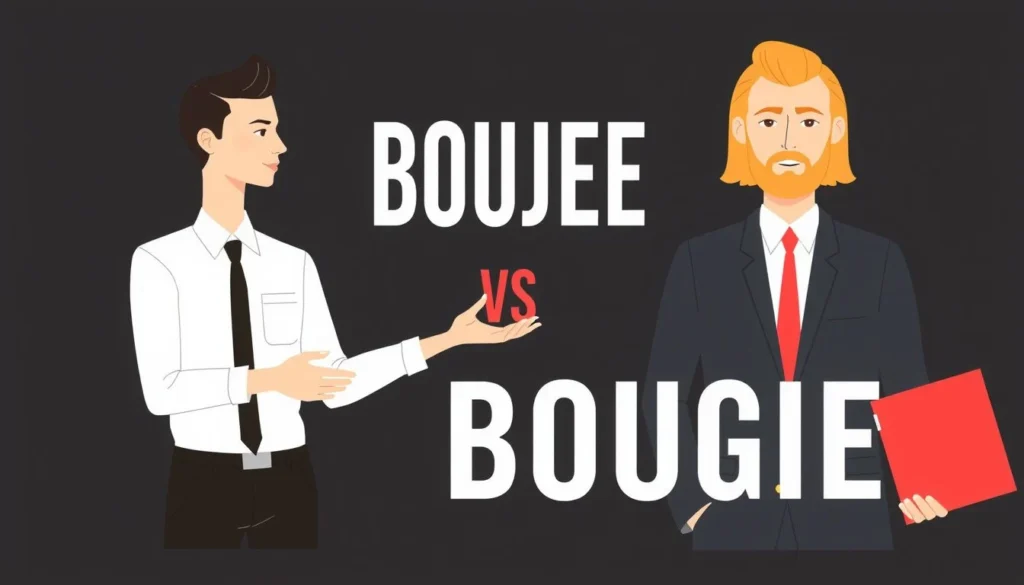
Q: What is the difference between boujee and bougie?
A: Both come from the same French root. “Bougie” is the older American spelling and often carries a critical or teasing tone about pretentiousness. “Boujee” is the newer spelling popularized by Migos in 2016 and carries a positive, aspirational tone about luxury and high class.
Q: Do French people understand what boujee means?
A: Most French people would not immediately understand “boujee” as an American slang term. They might connect it to “bourgeois” or “bourge,” but the positive American meaning would likely be lost. They would probably interpret it as a strange pronunciation of their word for “posh.”
Q: What should I say instead of boujee in French?
A: To compliment something as fancy or luxurious in French, say “chic” (stylish), “classe” (classy), “luxueux” (luxurious), or “haut de gamme” (high end). These carry the positive meaning that “boujee” has in American English.
Q: Is boujee an insult in French?
A: The French root “bourgeois” and the slang “bourge” are generally insults or criticisms. They imply that someone is materialistic, conventional, and out of touch. So if you use “boujee” in France, it may be heard as an insult even if you meant it as a compliment.
Q: Where did the word boujee come from?
A: Boujee comes from the French “bourgeois,” which entered English through political theory and was shortened to “bougie” in Black American English. The spelling “boujee” was popularized by the 2016 Migos song “Bad and Boujee,” which shifted the meaning from critical to celebratory.
Q: What does bourgeois mean literally in French?
A: Literally, “bourgeois” means “of the town” or “town dweller.” It originally referred to the merchant class that lived in cities, as opposed to peasants in the countryside or the nobility. Over time, it took on the connotation of conventional, materialistic middle class values.
Q: Why does boujee mean something different in French and English?
A: The difference comes from cultural attitudes toward wealth. American culture tends to celebrate wealth and luxury as achievements, so “boujee” became positive. French culture has a long intellectual tradition of criticizing the wealthy for their values, so “bourgeois” remained negative.
References & Further Reading
- Merriam-Webster: Bougie Definition and Etymology
- Cambridge Dictionary: Bourgeois
- Collins French-English Dictionary: Bourgeois
- Pierre Bourdieu, “Distinction: A Social Critique of the Judgement of Taste” (Harvard University Press, 1984)
- Word Origins: The History of Bougie and Boujee
—
About This Article
This article was researched and written by a bilingual language specialist with over a decade of experience teaching French and explaining cross cultural linguistic differences to English speakers. The analysis draws on standard French dictionaries, historical linguistics sources, and the sociological work of Pierre Bourdieu to provide an accurate picture of how “boujee” functions differently in American English and French. Every claim about French usage reflects current standard usage among native speakers in France.