The meaning of boujee is one of those things people argue about at parties. Someone calls a friend boujee for ordering the expensive wine, and suddenly everyone has a different definition. Is it a compliment? An insult? A lifestyle? The short answer: it’s complicated, and that’s what makes it interesting.
Quick Answer: Boujee (also spelled bougie) means acting or appearing wealthy, upper-class, or high-maintenance. It comes from the French word “bourgeois,” and today it can be either a playful tease or a genuine criticism, depending on context and tone.
This guide breaks down where the word came from, how its meaning shifted over time, what boujee actually looks like in daily life, and how to use it without sounding out of touch. You’ll also learn the difference between boujee and bougie, which matters more than most people think.
Where Boujee Actually Comes From
The word boujee has a surprisingly long history. It didn’t start with a Migos song, though that’s where most people first heard it.
The French Connection
Boujee traces back to the French word bourgeois, which originally described someone who lived in a town (a “bourg”) rather than working the land. Over centuries, bourgeois evolved to mean the middle class, specifically people with property, money, and a certain set of social values. Karl Marx used the term to describe the capitalist class that owned the means of production.
That’s the academic root. But slang doesn’t care about academic roots.
From Bourgeois to Bougie to Boujee
In American English, “bourgeois” got shortened to bougie (pronounced BOO-zhee) sometime in the 1960s and 1970s, particularly in Black American communities. It was often used to describe someone who had achieved middle-class status but was seen as acting superior or forgetting where they came from.
Then came 2016. The song “Bad and Boujee” by Migos featuring Lil Uzi Vert turned the word into a global phenomenon. The spelling shifted from bougie to boujee, and the meaning softened. Instead of a criticism, boujee became aspirational. Being boujee meant you had nice things, and you weren’t sorry about it.
The song hit number one on the Billboard Hot 100 in January 2017, and the word has been mainstream ever since.
Pro Tip: If you’re writing about this word in a formal context, use “bougie” as the standard spelling. “Boujee” is the slang variant popularized by hip-hop culture. Both are correct, but they carry slightly different connotations.
Boujee vs Bougie: What’s the Difference?
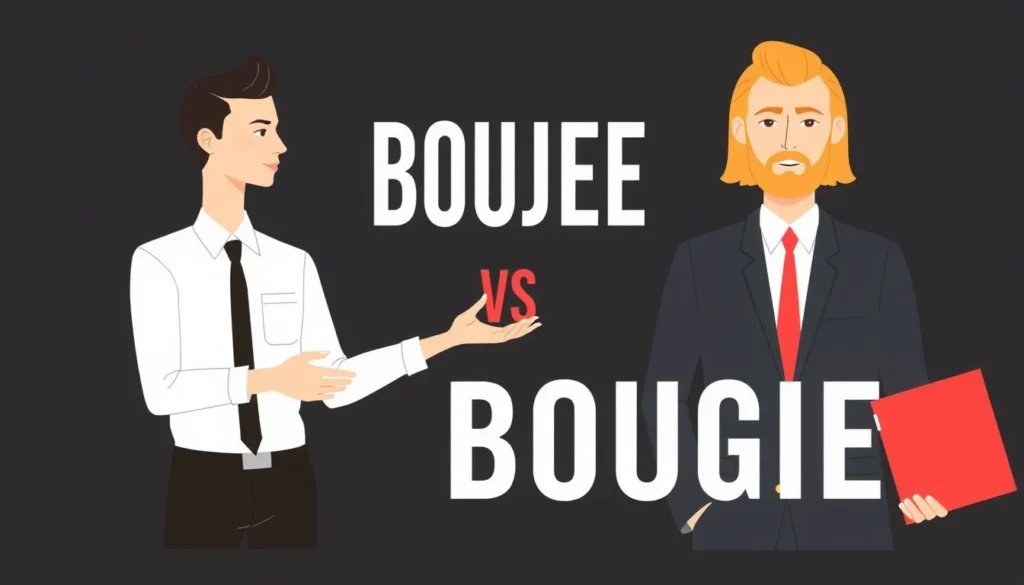
People use these two spellings interchangeably, but there’s a meaningful distinction.
| Aspect | Bougie | Boujee |
|---|---|---|
| Origin | Shortened from bourgeois, 1960s-70s | Popularized by Migos song, 2016 |
| Connotation | Often negative, implies pretension | Often playful or aspirational |
| Typical usage | “She’s so bougie, she won’t eat fast food” | “That hotel was boujee as hell” |
| Class implication | Middle-class trying to seem upper-class | Actually having or enjoying luxury |
| Tone | Judgment | Admiration, sometimes with humor |
The short version: bougie is an accusation, boujee is a flex. When someone calls you bougie, they’re usually saying you’re trying too hard. When someone calls you boujee, they might be impressed, or they might be teasing you for spending $14 on a smoothie. Context is everything.
What Boujee Actually Looks Like in Real Life
The meaning of boujee becomes clearer when you see it in action. Here are the common signs someone might call boujee:
- They have strong opinions about water. Bottled, filtered, sparkling, pH-balanced. Tap water is for peasants.
- They order “off-menu” items at restaurants, or make substitutions to everything.
- Their coffee order has more than four words in it. Oat milk, half-caf, extra shot, light foam.
- They own things “for aesthetic purposes only.” Candles they never burn, books they never read, a cheese board shaped like a state.
- They use “summer” as a verb. “We summer in Maine” is a boujee sentence.
- They have a skincare routine with more steps than their morning commute.
- They’ve said the phrase “I don’t do well in economy” and meant it.
None of these are inherently bad. The boujee lifestyle is just a specific way of prioritizing comfort, aesthetics, and quality over convenience or cost. Some people admire it. Others find it exhausting.
The Boujee Mindset
What separates boujee from simply “liking nice things” is the performance. A person who quietly enjoys good coffee isn’t necessarily boujee. A person who posts their good coffee on Instagram with a caption about “elevating the morning ritual” might be.
Boujee is as much about signaling as it is about consuming. The boujee person wants you to know they have standards. The boujee person has a favorite brand of olive oil and will tell you about it unprompted.
How the Meaning Shifted Over Time
Language evolves, and boujee is a perfect case study.
In the 1970s and 80s, calling someone bougie in Black American communities was often a critique. It suggested the person had money but had lost touch with their roots. It was about authenticity, not aesthetics.
By the 2000s, bougie had spread beyond those communities. It became a general term for anyone perceived as pretentious or overly concerned with status.
Then 2016 happened. “Bad and Boujee” flipped the script. The song celebrated wealth and luxury without apology. Being boujee wasn’t embarrassing anymore. It was a goal.
Today, the meaning of boujee depends heavily on who’s saying it and how. A teenager calling their friend boujee for having AirPods Max is probably teasing. A coworker calling you boujee for bringing a French press to the office might be half-admiring, half-annoyed. A family member calling you boujee at Thanksgiving is probably making a point about how you’ve changed.
Pro Tip: Pay attention to tone and relationship. Boujee from a close friend is usually playful. Boujee from someone you barely know might carry more judgment. When in doubt, ask.
How to Use Boujee Correctly
Using boujee wrong is worse than not using it at all. Here’s a quick guide.
When It Works
- Describing a genuinely luxurious experience: “That rooftop bar was boujee.”
- Teasing a friend affectionately: “You brought your own avocado toast to brunch? Boujee.”
- Self-deprecating humor: “I know I’m boujee, but I can’t drink hotel coffee.”
When It Doesn’t
- In formal writing. Don’t put boujee in a work email or academic paper.
- When you’re trying to insult someone seriously. Boujee is too playful for real criticism. Use “pretentious” or “out of touch” instead.
- When you’re describing something that’s just expensive. A $500,000 car isn’t boujee, it’s just rich. Boujee implies a certain aesthetic sensibility, not just money.
The word works best when there’s a hint of humor or irony involved. It’s a wink, not a weapon.
The Cultural Context You Should Know
You can’t fully understand the meaning of boujee without acknowledging its cultural journey.
The term originated in Black American English and was popularized globally through hip-hop. When non-Black people use boujee, they’re borrowing from a linguistic tradition that spans decades. That’s not automatically a problem, but it’s worth being aware of.
The word’s evolution also reflects broader conversations about class in America. Boujee sits at the intersection of race, class, and aspiration. It can describe the tension between wanting nice things and being judged for wanting them. It can celebrate upward mobility or critique it. That complexity is part of why the word has stuck around.
When you use boujee, you’re participating in a long cultural conversation. Knowing that makes you a more thoughtful speaker, and it helps you understand why the word hits differently in different contexts.
Key Takeaways
- Boujee comes from “bourgeois” and was popularized in its current spelling by the 2016 Migos song “Bad and Boujee”
- Bougie and boujee aren’t exactly the same , bougie implies pretension, boujee implies aspirational luxury
- Tone determines meaning , boujee can be a compliment, a tease, or a criticism depending on context
- The word has deep cultural roots in Black American English and carries class-related nuances
- Use it casually, not formally , boujee belongs in conversation and social media, not professional writing
Frequently Asked Questions
Q: What does boujee mean in slang?
A: In slang, boujee means acting or appearing wealthy, upper-class, or high-maintenance. It describes someone who enjoys luxury, has expensive taste, or presents themselves as sophisticated. The term can be playful or critical depending on context.
Q: Is boujee a compliment or an insult?
A: Boujee can be either. When used playfully among friends, it’s often a lighthearted compliment about someone’s taste or standards. When used with a certain tone, it can imply someone is pretentious, materialistic, or out of touch. The speaker’s tone and relationship to the person matter more than the word itself.
Q: What’s the difference between boujee and bougie?
A: Bougie is the older spelling and tends to carry a more negative connotation, implying pretension or trying too hard to seem upper-class. Boujee, popularized by the Migos song “Bad and Boujee,” is more playful and aspirational. Bougie judges, boujee celebrates.
Q: Where does the word boujee come from?
A: Boujee comes from the French word “bourgeois,” which historically referred to the middle class. It was shortened to “bougie” in American slang during the 1960s and 1970s, then respelled as “boujee” after the 2016 Migos song brought it into mainstream use.
Q: Is boujee the same as rich?
A: No. Being rich means having money. Being boujee means having a particular aesthetic or attitude about luxury. Someone can be boujee without being wealthy, and many wealthy people are not boujee at all. Boujee is about taste, presentation, and priorities, not just income.
Q: How do you pronounce boujee?
A: Boujee is pronounced BOO-zhee. The first syllable rhymes with “too,” and the second syllable sounds like the “si” in “vision.” It’s the same pronunciation as bougie.
Q: Can you call a man boujee?
A: Yes. While boujee is sometimes associated with feminine-coded interests like skincare or home decor, anyone can be boujee. A man who insists on single-origin coffee and bespoke tailoring is just as boujee as anyone else.
Q: Is boujee a negative word?
A: Not inherently. Boujee has a range of meanings from admiring to critical. In many contexts today, it’s used affectionately or as a form of self-description. The negativity depends entirely on delivery and intent.
Q: What is an example of boujee behavior?
A: Common examples include refusing to drink tap water, ordering complex coffee drinks, bringing your own hot sauce to restaurants, insisting on organic everything, and posting photos of aesthetically arranged meals. It’s about visible standards and preferences.
Q: When did boujee become popular?
A: Boujee entered mainstream vocabulary in late 2016 and early 2017, driven by the success of “Bad and Boujee” by Migos featuring Lil Uzi Vert. The song reached number one on the Billboard Hot 100 in January 2017.
References & Further Reading
- Merriam-Webster: Bougie Definition , Standard dictionary entry covering etymology and usage
- Dictionary.com: Boujee Meaning , Detailed breakdown of the slang term’s history and cultural context
- Billboard: Bad and Boujee Chart History , Chart data confirming the song’s number one position
- Etymology Online: Bourgeois , Historical etymology of the root word
—
About This Article: This guide was researched and written based on standard dictionary sources, etymology references, and cultural analysis of the term’s usage in American English. The goal is to provide an accurate, nuanced understanding of boujee that goes beyond surface-level definitions.

Pingback: Boujee vs Bougie Meaning: The Real Difference Explained
Pingback: 999 Angel Number Meaning: Why You Keep Seeing 999 (2026)
Pingback: 222 Angel Number Meaning: What Seeing 222 Means for You