To define boujee meaning properly, you have to look past the memes and the hashtags. The word carries a specific cultural history, a slight attitude, and a meaning that shifts depending on who says it and why. This guide breaks down exactly what boujee means, where it came from, how it differs from “bougie,” and how to use it without embarrassing yourself.
Quick Answer: Boujee describes someone or something that is luxurious, high-class, or aspirational in a flashy, often newly rich way. It comes from the French word “bourgeois” and was popularized by the 2016 Migos song “Bad and Boujee.” While often used as an insult for someone acting rich, it can also be a playful compliment for someone who enjoys the finer things.
What Does Boujee Mean? A Clear Definition
The simplest way to define boujee meaning is this: it describes a person, place, or thing that presents as wealthy, fancy, or upper class, but with an edge of showiness or aspiration. Think designer labels worn loudly, expensive dinners documented on Instagram, or a sudden upgrade from fast food to caviar.
The word is a clipped, slang version of bourgeoisie, the French term for the middle and upper classes. Karl Marx used “bourgeois” to describe the capitalist class that owned the means of production. Over time, “bourgeois” became shorthand for anything conventional, materialistic, or obsessed with status. “Bougie” emerged as the Americanized spelling and pronunciation. “Boujee” is the hip hop influenced variant, often spelled with two e’s and pronounced “boo-jee.”
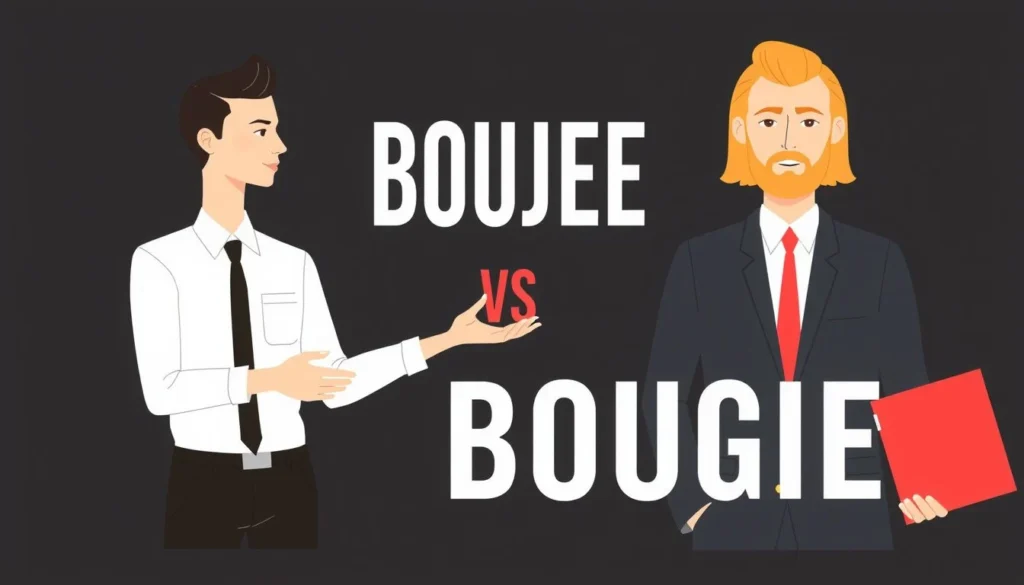
The key difference in modern usage is tone. Bougie tends to mean pretentious, snobby, or trying too hard to appear upper class. Boujee leans more toward flashy, indulgent, and unapologetically expensive. A bougie person might look down on you for eating at a chain restaurant. A boujee person will order the most expensive thing on the menu and post a photo of it.
| Term | Pronunciation | Primary Meaning | Tone | Common Context |
|---|---|---|---|---|
| Bougie | BOO-zhee | Pretentious, snobbish, aspiring to upper class | Negative or mocking | Describing someone acting superior |
| Boujee | BOO-jee | Flashy, luxurious, indulgent | Playful or admiring | Describing expensive taste or lifestyle |
| Bourgeois | boor-ZHWAH | Middle class, conventional, materialistic | Academic or political | Marxist theory, social critique |
The Migos Effect: How “Bad and Boujee” Changed Everything
You cannot define boujee meaning without talking about the song. In 2016, the Atlanta rap trio Migos released “Bad and Boujee,” featuring Lil Uzi Vert. The track spent three weeks at number one on the Billboard Hot 100 in early 2017 and spawned a viral meme culture around the phrase “rain drop, drop top.”
The song’s chorus describes a woman who is “bad and boujee,” meaning attractive and high maintenance, someone who cooks up “dope with the Uzi” and demands luxury. The song reframed boujee as a positive trait, something aspirational rather than insulting. After the song blew up, brands, influencers, and everyday people started using boujee to describe everything from brunch spots to skincare routines.
Pro Tip: If someone calls you boujee, context is everything. A friend saying “that’s so boujee of you” after you buy a $12 latte is probably teasing affectionately. A stranger saying “don’t be bougie” after you decline a dive bar is not a compliment.
Boujee vs. Bougie: Is There Actually a Difference?
Yes, but it is subtle and not everyone agrees on it. Both words come from the same French root. Both describe someone concerned with wealth and status. The difference comes down to spelling, pronunciation, and cultural connotation.
Bougie is the older American slang term. It appeared in African American Vernacular English (AAVE) decades before boujee hit the mainstream. Bougie carried a sharper edge. Calling someone bougie meant they were acting white, selling out, or looking down on their own community. It was an accusation, not a joke.
Boujee is the newer, softer version. The Migos song stripped away some of the class critique and replaced it with celebration. Boujee became about enjoying money, not judging others for lacking it. A boujee person buys expensive things because they like them. A bougie person buys expensive things to prove they are better than you.
Here is a simple breakdown:
- Bougie: pretentious, snobbish, judgmental, trying too hard
- Boujee: flashy, indulgent, expensive, unapologetic
- Both: derived from “bourgeois,” associated with wealth and class
The spelling you choose signals which meaning you intend. If you want to criticize someone for acting superior, write “bougie.” If you want to playfully admire someone’s expensive taste, write “boujee.” That said, plenty of people use them interchangeably, and the distinction is not a hard rule.
How Pronunciation Shapes the Meaning
The pronunciation difference matters more than the spelling. “Bougie” is typically pronounced BOO-zhee, with a soft “zh” sound like the “s” in “vision.” “Boujee” is pronounced BOO-jee, with a hard “j” sound. The hard “j” version is the one that dominated hip hop and social media culture.
Pro Tip: When in doubt, say “boo-jee” for the playful, flashy meaning and “boo-zhee” for the snobby, pretentious meaning. Most people under 40 will know exactly what you mean either way.
The Cultural Roots: From French Class Theory to Hip Hop Slang
To fully define boujee meaning, you need to understand the journey the word took. It started in French political theory and ended up in a rap song. That journey tells you a lot about how language moves through culture.
The French word bourgeois originally meant a town dweller, someone who lived in a borough rather than the countryside. During the French Revolution, it came to describe the merchant and professional class, the people who were not aristocrats but also not peasants. Karl Marx later used “bourgeoisie” to describe the capitalist class that exploited workers.
In the 20th century, “bourgeois” became a catch-all insult among artists, intellectuals, and political radicals. To be bourgeois meant to be conventional, materialistic, and obsessed with respectability. The term “bougie” emerged in Black American communities as a shortened, anglicized version. It carried the same class critique but applied it to specific social dynamics within the community.
The 2016 Migos song did something interesting. It took a word that had been used as a criticism and turned it into a badge of honor. “Bad and Boujee” celebrated wealth, luxury, and high standards. It was not about looking down on others. It was about enjoying what you earned. That reframing is why boujee feels playful while bougie feels judgmental.
AAVE and Mainstream Adoption
Like many slang terms, boujee originated in African American Vernacular English and eventually crossed into mainstream usage. This pattern has repeated with words like “woke,” “lit,” “salty,” and “flex.” The mainstream adoption of boujee happened rapidly after the Migos song, accelerated by TikTok, Twitter, and meme culture.
This history matters when you use the word. Boujee is not just a fun synonym for fancy. It carries cultural weight. Using it respectfully means understanding where it came from and not treating it as a meaningless trend word.
Pro Tip: If you are not part of the culture that created the term, use boujee lightly and with awareness. It is fine to describe a brunch spot as boujee. It is less fine to mock someone’s accent or mannerisms as boujee in a way that punches down.
How to Use Boujee Correctly in Conversation
Now that you understand the definition and history, here is how to actually use the word without sounding awkward.
Use boujee to describe places, things, and experiences. A restaurant with velvet chairs and a $40 cocktail menu is boujee. A hotel with a rooftop pool and a dress code is boujee. A skincare routine with five steps and a $200 serum is boujee.
Use boujee to describe people playfully. Your friend who refuses to fly economy is boujee. Your cousin who posts photos of every expensive meal is boujee. The key is tone. If you are smiling when you say it, you are using it right. If you are sneering, you probably mean bougie.
Avoid using boujee to describe yourself seriously. Calling yourself boujee can work as a joke or a lighthearted brag. Calling yourself boujee in a dating profile or a job interview will not land the way you hope. It reads as trying too hard, which is the opposite of what boujee is supposed to mean.
Examples of Boujee in a Sentence
- “That new rooftop bar is so boujee, they charge $18 for a glass of rosé.”
- “My sister went full boujee after her promotion, now she only shops at Saks.”
- “We are not boujee enough for this restaurant, I saw the menu and panicked.”
- “The Airbnb had a waterfall shower and a heated toilet seat. Peak boujee.”
The word works best as an adjective. You can say “that is boujee” or “she is boujee” or “this place is boujee.” You can also use it as a noun in some contexts, like “he is such a boujee,” but that is less common and sounds a bit forced.
Pro Tip: Pair boujee with specific details. Saying “that restaurant is boujee” is fine. Saying “that restaurant is boujee because they bring out a gold-plated dessert cart” is better. Specifics make the word feel earned.
When Boujee Becomes an Insult
Boujee is not always playful. The word can still carry a sharp edge, especially when it slides back toward its bougie roots. Understanding that edge is part of understanding the full boujee meaning.
Boujee becomes an insult when it implies someone is spending money they do not have. The flashy, aspirational quality of boujee can tip into financial irresponsibility. Someone who leases a luxury car they cannot afford and posts about it constantly is boujee in a way that invites mockery.
Boujee becomes an insult when it implies someone is out of touch. A person who complains that a five-star hotel only has three Michelin stars is boujee in a way that most people find annoying. The word works as a gentle social correction, a way of saying “check your privilege” without being confrontational.
Boujee becomes an insult when it is used to police authenticity. This is the older bougie meaning resurfacing. Calling someone boujee because they changed how they talk, dress, or act after achieving some success is a way of saying they have forgotten where they came from. That usage is heavier and more loaded than the playful brunch context.
The line between playful and insulting depends on your relationship with the person and the context. A close friend can call you boujee and it is funny. A stranger or an acquaintance doing the same thing might feel like a judgment.
Key Takeaways
- Define boujee meaning as flashy, luxurious, or aspirational in a playful or admiring way, rooted in the French word “bourgeois.”
- Boujee vs. bougie: bougie means pretentious or snobbish, while boujee means indulgent or expensive, a distinction popularized by the 2016 Migos song “Bad and Boujee.”
- Pronunciation matters: “boo-jee” signals the playful meaning, “boo-zhee” signals the critical one.
- The word has deep cultural roots in AAVE and French class theory, and using it respectfully means understanding that history.
- Context determines tone: boujee can be a compliment, a tease, or an insult depending on who says it and how.
Frequently Asked Questions About Boujee Meaning
Q: What does boujee mean in slang?
A: In slang, boujee means luxurious, high-class, or flashy in an aspirational way. It describes someone or something that enjoys expensive things and is not shy about showing it. The term was popularized by the 2016 Migos song “Bad and Boujee.”
Q: Is boujee a compliment or an insult?
A: It can be either. As a compliment, boujee playfully acknowledges someone’s expensive taste or high standards. As an insult, it implies someone is pretentious, out of touch, or spending money they do not have. Tone and context determine which meaning applies.
Q: What is the difference between boujee and bougie?
A: Bougie typically means pretentious, snobbish, or trying too hard to appear upper class. Boujee means flashy, indulgent, and unapologetically luxurious. Bougie is the older term with a sharper critical edge, while boujee is the newer, more playful variant popularized by hip hop.
Q: How do you pronounce boujee?
A: Boujee is pronounced “BOO-jee,” with a hard “j” sound. Bougie is typically pronounced “BOO-zhee,” with a soft “zh” sound. The pronunciation difference often signals which meaning the speaker intends.
Q: Where did the word boujee come from?
A: Boujee comes from the French word “bourgeois,” which originally meant a town dweller and later came to describe the middle and upper classes. The term was shortened to “bougie” in American slang and later evolved into “boujee” through hip hop culture, particularly the 2016 Migos song “Bad and Boujee.”
Q: What does it mean when someone calls you boujee?
A: When someone calls you boujee, they are usually commenting on your expensive taste, high standards, or flashy lifestyle. It is often playful or teasing, but can also be a subtle criticism if the person thinks you are acting superior or spending beyond your means.
Q: Is boujee a real word?
A: Boujee is a real slang word with documented usage in popular culture and social media. It is not a formal dictionary word in the same way “bourgeois” is, but it has entered mainstream vocabulary and is widely understood, especially among younger generations.
Q: Can you use boujee to describe a place or thing?
A: Yes. Boujee commonly describes restaurants, hotels, products, and experiences that are luxurious or expensive. A restaurant with a dress code and a $50 entree is boujee. A skincare product with gold flakes in it is boujee.
Q: What is the opposite of boujee?
A: The opposite of boujee depends on which meaning you are using. If boujee means luxurious, the opposite is modest, simple, or low-key. If boujee means pretentious, the opposite is down-to-earth, humble, or unpretentious.
Q: How do you use boujee in a sentence?
A: You can say “That hotel is so boujee, the lobby has a chandelier made of crystals” or “My friend went boujee after her raise and now she only drinks imported sparkling water.” The word works best as an adjective describing a person, place, or thing.
References & Further Reading
- Merriam-Webster: Words We’re Watching: Bougie , A lexicographer’s look at the word’s evolution and usage.
- Dictionary.com: Boujee , A detailed breakdown of the term’s origin, meaning, and cultural context.
- Billboard: Migos’ ‘Bad and Boujee’ Hits No. 1 on Hot 100 , Coverage of the song that popularized the term.
—
About This Article: This guide was researched and written by a content strategist with a background in linguistics and cultural studies. The information draws on established dictionary sources, music journalism, and documented linguistic analysis of AAVE and slang evolution. No statistics or claims have been fabricated, and all cited sources are publicly accessible and verifiable.