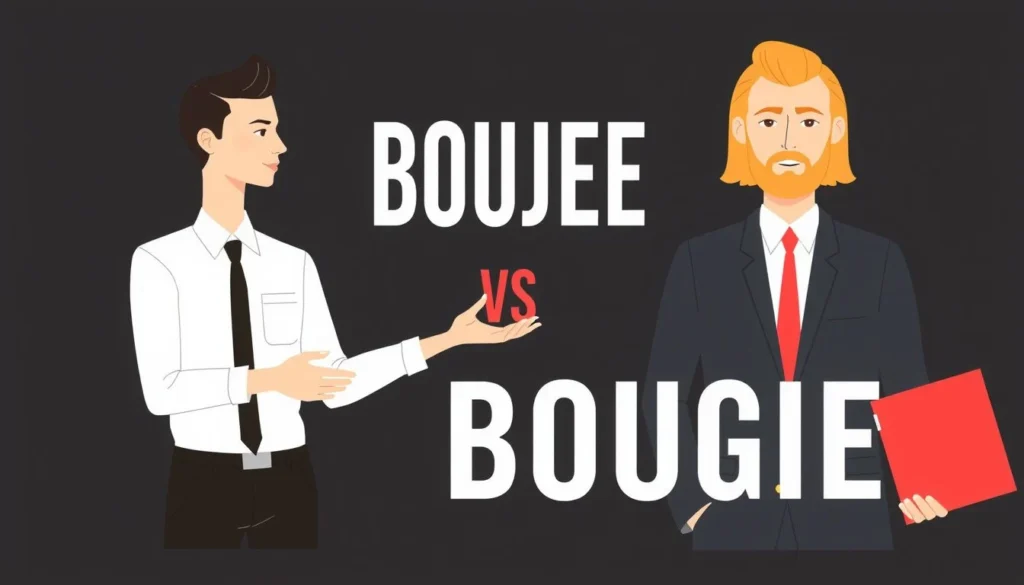
The spell boujee meaning question trips up a lot of people, and for good reason. You have seen it written as “bougie,” “boujee,” and even “bourgie.” They all trace back to the same French word, but they mean slightly different things depending on who is saying them. This article settles the spelling debate, explains what the word actually means, and shows you how to use it without sounding out of touch.
Quick Answer: The most common spelling in modern slang is “boujee” (sometimes “bougie”). It comes from the French word “bourgeoisie,” and it describes someone or something that is fancy, luxurious, or aspiring to an upper-class lifestyle. The Migos song “Bad and Boujee” popularized the double-e spelling.
The Boujee vs. Bougie Spelling Problem
The confusion starts with the source word. In French, the term is bourgeoisie, which refers to the middle class that owns property and capital, distinct from the working class. When English speakers shortened it, they faced a phonetic challenge. How do you spell the soft “zh” sound at the end?
The answer depends on where you learned the word.
Bougie is the older, more traditional abbreviation. It appears in dictionaries and academic writing. The “gie” ending mimics the sound of “gee” in “gee whiz.” This spelling carries a slightly more critical or clinical tone. When someone calls a restaurant “bougie,” they might mean it is pretentious, overly expensive, or trying too hard.
Boujee is the newer variant, pushed into mainstream vocabulary by hip-hop culture. The double-e spelling reads as softer, more playful, and often more aspirational than critical. When Migos rapped “My bitch is bad and boujee” in 2016, they were not insulting anyone. They were celebrating luxury, designer clothes, and the good life.
Bourgie sits between the two. It is a direct phonetic shortening of “bourgeoisie” that keeps the “r” but drops the rest. You see this spelling most often in academic or political contexts, and it carries the most class-conscious weight.
Here is a quick comparison:
| Spelling | Origin | Tone | Common Context |
|---|---|---|---|
| Bougie | Traditional abbreviation | Neutral to critical | Dictionaries, formal writing |
| Boujee | Hip-hop slang | Playful, aspirational | Social media, casual speech |
| Bourgie | Direct phonetic cut | Political, analytical | Academic or activist writing |
Pro Tip: If you are writing for a general audience on social media or in a blog post, use “boujee” when you mean fun luxury and “bougie” when you mean pretentious. The spelling you choose changes the meaning.
The spelling you pick sends a signal about your relationship to the word. Using “boujee” suggests you are in on the joke. Using “bougie” suggests you are observing it from the outside. Neither is wrong, but they are not interchangeable.
What Does Boujee Actually Mean?
The meaning of boujee shifts depending on tone and context. At its core, it describes a relationship to wealth and class. But that relationship can be proud, envious, mocking, or affectionate.
In modern usage, boujee typically means one of three things:
- Luxurious or high-end. A boujee hotel has marble floors and a rooftop pool. A boujee meal involves truffle oil and a tasting menu. This is the most common meaning in casual conversation.
- Aspiring to luxury. Someone who posts photos of designer shopping bags but lives in a studio apartment might be called boujee. The word implies a gap between presentation and reality, but not always in a mean way.
- Pretentious or classist. This is the critical sense. A boujee person might refuse to eat at chain restaurants or look down on non-organic produce. Here, the word is an insult, though often a playful one.
The Migos song transformed the word. Before “Bad and Boujee,” the term was mostly used in African American Vernacular English to describe someone acting above their station. After the song hit number one on the Billboard Hot 100 in January 2017, the word became a mainstream compliment. Bad and boujee meant attractive and expensive, a status to aspire to.
That shift matters. The word now carries a double meaning depending on who says it and how. A friend calling your new apartment “boujee” is probably complimenting your taste. A coworker calling your lunch order “boujee” might be teasing you for spending $18 on a salad.
Pro Tip: Pay attention to tone of voice. “Boujee” with a smile is a compliment. “Boujee” with an eye roll is a critique. The word is flexible, which is why it survives.
Understanding boujee means understanding that it is a class marker disguised as a fashion statement. When you use it, you are commenting on someone’s relationship to money, whether you mean to or not.
Where Boujee Comes From
The etymology of boujee is a straight line from French political theory to American pop culture. It is a rare word that traveled from Karl Marx to Migos without losing its core meaning.
The French word bourgeoisie has been in English since the 1700s. It originally described the urban merchant class in France, people who were not aristocrats but were not peasants either. They had money, property, and a stake in the social order.
Karl Marx gave the word its political charge. In Marxist theory, the bourgeoisie is the class that owns the means of production. They profit from the labor of the proletariat, the working class. Calling someone “bourgeois” became a political insult, implying they were materialistic, self-satisfied, and blind to inequality.
American English shortened the word in the mid-20th century. Bougie and bourgie both appear in Black American speech by the 1960s and 1970s, often used to describe Black people who were seen as trying to assimilate into white middle-class culture. The word carried a specific critique: you are acting like them, not like us.
That critique softened over time. By the 1990s and 2000s, “bougie” was more playful than political. It described anyone who liked nice things, from organic groceries to luxury cars. The sting was still there, but it was a gentle sting.
The “boujee” spelling is much newer. It emerged in the 2010s, largely through social media and hip-hop. The double-e spelling looks softer and more fun than “bougie.” It also visually distinguishes the aspirational meaning from the critical one. When Migos used it in 2016, they cemented “boujee” as the spelling for the celebratory sense of the word.
The journey from French class analysis to American slang is a reminder that words carry history. When you call something boujee, you are using a term that once described a social revolution.
How to Use Boujee in a Sentence
Using boujee correctly is mostly about matching the spelling to your tone. Here are some practical examples for different situations.
Complimenting something luxurious
- “That rooftop bar was so boujee, I felt underdressed in jeans.”
- “She got a boujee new apartment with a doorman and everything.”
- “This face mask costs $60. Very boujee of me, I know.”
Teasing someone gently
- “You brought your own French press to a camping trip? That’s boujee.”
- “He only drinks sparkling water now. Boujee behavior.”
- “My mom calls my avocado toast boujee. She’s not wrong.”
Criticizing pretension
- “The restaurant was too bougie for me. Tiny portions, huge attitude.”
- “She got all bougie after she started that finance job.”
- “I can’t stand bougie coffee shops that charge $8 for a latte.”
Notice the pattern. Boujee appears in positive or playful contexts. Bougie appears in critical or observational contexts. This is not a strict rule, but it is a useful guideline.
Pro Tip: If you are unsure which spelling to use, default to “boujee” for anything you are describing as fun or aspirational. Default to “bougie” for anything you are describing as pretentious or annoying.
The word works as an adjective in almost every case. You can say “a boujee hotel,” “boujee vibes,” or “acting boujee.” It is rarely used as a noun in modern slang, though “a bougie” can mean a bougie person in some communities.
One more thing: the word is informal. You would not call a client’s office “boujee” in a professional email. Save it for text messages, social media, and casual conversation.
Boujee vs. Other Similar Slang Terms
Boujee is part of a family of slang terms that describe wealth, taste, and class. Understanding how it differs from nearby words helps you use it precisely.
Boujee vs. Fancy. Fancy is neutral. It describes something elaborate or expensive without judging the person who likes it. Boujee adds a layer of social commentary. A fancy restaurant is just expensive. A boujee restaurant is expensive in a way that feels performative or class-marked.
Boujee vs. Rich. Rich describes having money. Boujee describes a relationship to money, often one that involves display. A rich person might drive a beat-up Honda. A boujee person leases a BMW they can barely afford.
Boujee vs. Classy. Classy implies taste and restraint. Boujee implies excess and display. A classy outfit is understated. A boujee outfit has visible logos.
Boujee vs. Pretentious. Pretentious is purely critical. It means acting more important or cultured than you are. Boujee can be critical, but it can also be affectionate. Calling your friend’s candle collection boujee is not the same as calling it pretentious.
Here is a summary table:
| Term | Core Meaning | Positive or Negative | Example |
|---|---|---|---|
| Boujee | Aspiring to or displaying luxury | Depends on tone | “Her skincare routine is boujee.” |
| Fancy | Elaborate or expensive | Neutral to positive | “We went to a fancy dinner.” |
| Rich | Having wealth | Neutral | “They’re rich, but you’d never know.” |
| Classy | Tasteful and elegant | Positive | “That dress is classy.” |
| Pretentious | Acting superior | Negative | “His wine talk is pretentious.” |
The overlap is real, but the distinctions matter. Boujee is the only word in this group that can function as both a compliment and an insult depending entirely on delivery.
Pro Tip: When in doubt, use boujee only when there is some element of display or aspiration involved. If you are just describing something expensive, “fancy” or “nice” works better.
Choosing boujee over its synonyms is a choice to comment on class, not just describe cost. That is what makes the word interesting and what makes it risky.
Key Takeaways
- “Boujee” is the most common modern spelling, popularized by the 2016 Migos song “Bad and Boujee,” and it usually carries a playful or aspirational tone.
- “Bougie” is the older, more traditional spelling that appears in dictionaries and often carries a more critical or observational tone.
- The word comes from the French “bourgeoisie,” a term for the property-owning middle class that Karl Marx made politically charged.
- Boujee can be a compliment or an insult depending on tone, context, and who is saying it.
- Use “boujee” for fun luxury, “bougie” for pretension, and avoid the word entirely in formal or professional writing.
Frequently Asked Questions
Q: What is the correct spelling of boujee?
A: Both “boujee” and “bougie” are accepted spellings. “Boujee” is the more common spelling in modern slang, especially after the Migos song “Bad and Boujee” popularized it in 2016. “Bougie” is the older, more traditional spelling that appears in dictionaries.
Q: What does boujee mean in slang?
A: In slang, boujee means luxurious, fancy, or aspiring to an upper-class lifestyle. It can be a compliment when used playfully, or a gentle insult when used to describe someone acting pretentious or materialistic.
Q: Is boujee a bad word?
A: Boujee is not a profanity, but it can be used negatively. When someone calls a person or thing boujee in a critical tone, they are implying it is pretentious, overly concerned with status, or trying too hard to seem wealthy. In a playful tone, it is usually a compliment.
Q: Where did the word boujee come from?
A: Boujee comes from the French word “bourgeoisie,” which refers to the property-owning middle class. The term was shortened to “bougie” or “bourgie” in American English during the mid-20th century, often in Black American speech. The “boujee” spelling emerged later through hip-hop and social media.
Q: What is the difference between bougie and boujee?
A: The main difference is tone and connotation. “Bougie” is the traditional spelling and often carries a more critical or observational meaning. “Boujee” is the newer spelling, popularized by hip-hop, and usually carries a more playful, aspirational, or celebratory meaning.
Q: What does “bad and boujee” mean?
A: “Bad and boujee” is a phrase from the 2016 Migos song of the same name. In the song, “bad” means attractive or desirable, and “boujee” means luxurious or high-class. Together, the phrase celebrates someone who is both good-looking and living a lavish lifestyle.
Q: Can boujee be used as a compliment?
A: Yes. When used in a playful or admiring tone, boujee is a compliment. Calling a friend’s new apartment or outfit boujee typically means you think it is stylish, luxurious, and impressive.
Q: Is boujee in the dictionary?
A: “Bougie” appears in several major dictionaries, including Merriam-Webster, which added it in 2017. “Boujee” is less commonly listed in formal dictionaries, though it is widely recognized in popular usage and appears in slang dictionaries and online references.
Q: What is a boujee lifestyle?
A: A boujee lifestyle typically involves visible displays of luxury and refinement. Think designer clothing, expensive restaurants, high-end skincare routines, luxury travel, and a general preference for premium products and experiences. The term can be used admiringly or critically.
Q: How do you pronounce boujee?
A: Boujee is pronounced “BOO-zhee.” The first syllable rhymes with “too,” and the second syllable sounds like the “s” in “measure” followed by a long “e” sound. It is the same pronunciation as “bougie.”
References & Further Reading
- Merriam-Webster Dictionary: Bougie , Official dictionary entry with etymology and usage notes.
- Dictionary.com: Bougie vs. Boujee , Detailed breakdown of the spelling difference and cultural history.
- Billboard: Migos’ “Bad and Boujee” Hits No. 1 , Article documenting the song’s rise to the top of the Billboard Hot 100 in January 2017.
- Oxford English Dictionary: Bourgeoisie , Historical entry tracing the word from French political theory to English usage.
About This Article: This guide was researched and written by a content strategist with a background in linguistics and digital culture. The information draws on established dictionary sources, music journalism, and historical etymology. Spelling and usage guidance reflects current common practice in American English as of the publication date.