If you have ever scrolled through TikTok comments or heard a friend describe a $14 avocado toast as “boujee,” you have probably wondered about the exact boujee urban dictionary definition. The word gets thrown around constantly, but its meaning shifts depending on who is saying it and why. Some people use it as a compliment. Others use it as a roast. Most people use it somewhere in between.
This article breaks down what boujee actually means according to Urban Dictionary, how it differs from similar words like “bougie,” where the term came from, and how to use it without sounding out of touch. You will also get a clear comparison table, real examples from pop culture, and answers to the most common questions people ask about boujee.
Quick Answer: On Urban Dictionary, “boujee” means acting or appearing wealthy, luxurious, or high-class, often in a way that feels exaggerated, aspirational, or newly acquired. It is a phonetic spelling of “bougie,” which comes from the French word “bourgeois.”
What Is the Boujee Urban Dictionary Definition?
The most upvoted definition on Urban Dictionary describes boujee as “high class, flossin’, ballin’, one who possesses swag” and associates it with “expensive taste.” Another popular entry defines it as “acting richer than you actually are.” These two definitions capture the core tension of the word. Boujee can mean genuinely enjoying nice things, or it can mean putting on a performance of wealth that does not match your bank account.
The spelling matters. “Boujee” with two Js is the hip-hop influenced spelling popularized by Migos in their 2016 hit “Bad and Boujee.” “Bougie” with a G is the older, more traditional spelling that traces directly back to the French word bourgeois. Both words mean essentially the same thing, but “boujee” carries a slightly more playful, self-aware, and culturally specific connotation.
How Urban Dictionary Users Define Boujee
Urban Dictionary entries for boujee tend to emphasize a few recurring themes:
- Appearing wealthy or high-class without necessarily being rich
- Having expensive taste in food, fashion, travel, or lifestyle
- Acting superior to others because of perceived sophistication
- Enjoying luxury in a way that is fun and unapologetic rather than snobby
The tone of the word depends heavily on context. Calling your friend boujee because she ordered a $9 latte is affectionate teasing. Calling someone boujee because they refuse to eat at chain restaurants is closer to a criticism.
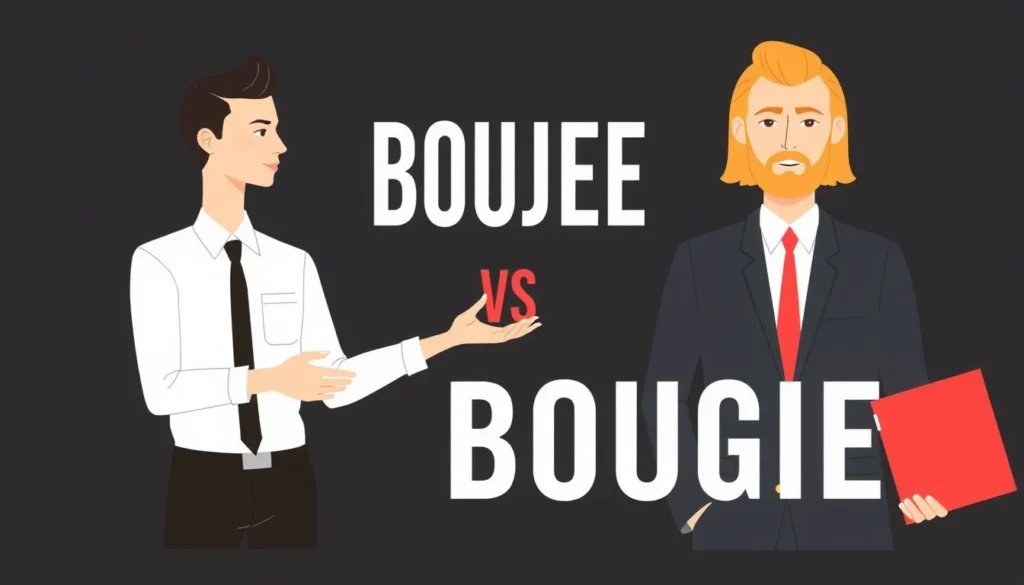
Boujee vs. Bougie: What Is the Difference?
Here is a quick comparison table to clarify how these two spellings differ in practice:
| Feature | Boujee | Bougie |
|---|---|---|
| Spelling origin | Phonetic respelling popularized by hip-hop | Direct shortening of “bourgeoisie” |
| Primary association | Pop culture, rap music, social media | Older usage, academic or critical contexts |
| Tone | Playful, self-aware, sometimes aspirational | Slightly more negative, classist critique |
| Famous usage | Migos, “Bad and Boujee” (2016) | General slang since the 1960s-70s |
| Core meaning | Liking luxury, acting rich, having expensive taste | Middle-class materialism, aspiring to upper-class status |
Pro Tip: If you are writing about the word in a formal context, use “bougie.” If you are quoting a song lyric, referencing meme culture, or talking casually, “boujee” is the better fit.
Where Did Boujee Come From?
The word boujee has a surprisingly long linguistic history. It did not start with Migos, and it did not start on Urban Dictionary either. The root word is bourgeois, a French term that originally referred to the middle class, specifically town dwellers who were neither peasants nor nobles. By the time Karl Marx used the term in the 19th century, “bourgeoisie” had become shorthand for the capitalist class, people who owned property and valued material wealth.
The shortened form “bougie” started appearing in African American Vernacular English (AAVE) during the mid-20th century. It was used to describe someone who acted middle-class, pretentious, or overly concerned with appearing sophisticated. The word carried a gentle critique, poking fun at people who tried too hard to distance themselves from working-class roots.
Then came 2016. Migos, the Atlanta rap trio, released “Bad and Boujee,” and the word exploded into mainstream consciousness. The song spent three weeks at number one on the Billboard Hot 100 in early 2017. Suddenly, “boujee” was everywhere: on t-shirts, in Instagram captions, in think pieces about slang appropriation, and in the vocabulary of people who had never heard the word “bourgeois” in their lives.
The Migos spelling, with the double J, deliberately leaned into the phonetic pronunciation. It made the word feel fresh, musical, and distinctly tied to hip-hop culture. That is the spelling Urban Dictionary users overwhelmingly prefer today.
How Is Boujee Used in Real Conversations?
Boujee is an adjective, but it gets used in a few different grammatical patterns. Understanding these patterns will help you use the word naturally instead of forcing it into a sentence where it does not belong.
Common Usage Patterns
- Describing a person: “She is so boujee, she only drinks sparkling water from glass bottles.”
- Describing an object or experience: “That restaurant is boujee, they charge $40 for a burger.”
- Describing an action: “We got boujee and booked a hotel with a rooftop pool.”
- Self-description with pride: “I am boujee and I am not sorry about it.”
The word works best when there is a slight gap between the luxury being described and the context around it. A billionaire flying a private jet is not boujee. That is just rich. Your cousin renting a Mercedes for a weekend trip is boujee. The word implies aspiration, effort, and a little bit of performance.
Boujee in Pop Culture
The Migos song remains the most famous usage, but boujee has appeared across the cultural landscape:
- Cardi B has used the word in interviews and lyrics to describe her post-fame lifestyle
- TikTok and Instagram are full of “boujee on a budget” content, where creators show affordable ways to feel luxurious
- Reality TV shows like The Real Housewives franchise are often described as peak boujee entertainment
- Food culture has embraced the term, with “boujee brunch” and “boujee coffee” becoming common phrases
The word has also spawned variations. “Boujee-adjacent” describes something that is almost luxurious but not quite. “Boujee behavior” is a playful accusation you might level at a friend who insists on ordering the most expensive item on the menu.
Pro Tip: Boujee works best when there is a wink involved. Using it completely seriously, like “I only associate with boujee individuals,” makes you sound like you missed the joke.
Is Being Boujee a Good Thing or a Bad Thing?
The answer depends on who is using the word and why. This ambiguity is part of what makes boujee such a useful and interesting term.
The Positive Reading
When used positively, boujee celebrates enjoying nice things. It acknowledges that luxury feels good, and that there is nothing wrong with wanting quality. A “boujee brunch” is not an insult; it is an invitation. Someone who describes themselves as boujee is often signaling that they have standards, that they know what they like, and that they are willing to spend money on experiences that bring them joy.
This positive reading is especially common among younger people who grew up with the word as a mainstream slang term. For them, boujee is not a class critique. It is a vibe.
The Negative Reading
When used negatively, boujee implies pretension, inauthenticity, or a desperate need to appear wealthy. Someone who is “acting boujee” is putting on airs. They are trying to seem more sophisticated than they actually are, and the effort is visible. This usage is closer to the original meaning of “bougie” as a critique of middle-class aspiration.
The negative reading also carries a class dimension. Calling someone boujee can be a way of saying, “You are not actually rich, so stop pretending.” It punctures the performance.
The Playful Middle Ground
Most real-world usage falls somewhere in between. Boujee is often a gentle tease between friends, a way of acknowledging that someone has expensive taste without condemning them for it. The word lets you comment on luxury without taking a firm moral stance.
The key takeaway: boujee is a flexible word. Pay attention to tone, context, and your relationship with the person you are describing. The same word can be a compliment, an insult, or a joke, depending on how you deliver it.
How to Use Boujee Correctly Without Sounding Out of Touch
Slang has a shelf life, and using it wrong is worse than not using it at all. Here is how to deploy boujee with confidence.
Do Not Overuse It
Boujee is a seasoning, not a main course. If every other sentence contains the word, you sound like you are trying too hard. Use it once per conversation, maybe twice, and let it land.
Match the Tone to the Context
Calling your coworker boujee because they brought a salad from a fancy deli is fine, assuming you have that kind of rapport. Calling your boss boujee in a performance review is a career-limiting move. The word is casual. Keep it that way.
Know Your Audience
Boujee is widely understood among people under 40, especially those who spend time on social media. Older audiences may know the word “bougie” but not the Migos spelling. If you are unsure, “bougie” is the safer choice. It is more established and less likely to confuse.
Do Not Use It to Describe Actual Wealth
A billionaire is not boujee. A luxury brand is not boujee. Boujee describes the performance of wealth or taste, not the wealth itself. If you use it to describe genuinely rich people, you are missing the point of the word.
Pro Tip: The easiest way to use boujee correctly is to attach it to a specific, slightly unnecessary luxury. “Boujee water,” “boujee candles,” “boujee airport lounge access.” The specificity is what makes it funny and accurate.
Key Takeaways
- Boujee means acting or appearing wealthy, luxurious, or high-class, often with a playful or aspirational edge, according to Urban Dictionary
- The word comes from “bourgeois”, a French term for the middle class, filtered through AAVE and popularized by Migos in 2016
- “Boujee” and “bougie” mean essentially the same thing, but “boujee” carries a more playful, pop-culture-inflected tone
- The word can be a compliment, an insult, or a joke, depending on tone, context, and the relationship between speaker and subject
- Boujee works best when it describes a specific, slightly unnecessary luxury, not actual wealth or genuine sophistication
Frequently Asked Questions About Boujee
Q: What does boujee mean on Urban Dictionary?
A: On Urban Dictionary, boujee means high class, flashy, or possessing expensive taste. The most popular definitions emphasize appearing wealthy or acting richer than you actually are, often with a playful or aspirational tone.
Q: Is boujee a compliment or an insult?
A: It can be either. Used playfully, boujee is a lighthearted tease about someone’s expensive taste. Used critically, it implies pretension or inauthentic displays of wealth. Context and tone determine the meaning.
Q: What is the difference between boujee and bougie?
A: Both words mean essentially the same thing, but “boujee” is the spelling popularized by Migos in their 2016 song “Bad and Boujee.” “Bougie” is the older spelling with more direct ties to the French word “bourgeois.” “Boujee” feels more playful and pop-culture-oriented.
Q: Where did the word boujee come from?
A: Boujee traces back to the French word “bourgeois,” meaning middle class. It was shortened to “bougie” in African American Vernacular English during the mid-20th century, then respelled as “boujee” by Migos in 2016.
Q: Who popularized the word boujee?
A: The rap group Migos popularized the spelling “boujee” with their 2016 hit single “Bad and Boujee,” which reached number one on the Billboard Hot 100 in early 2017.
Q: How do you use boujee in a sentence?
A: Examples include: “She is so boujee, she only drinks oat milk lattes from that place downtown.” “We got boujee and ordered the tasting menu.” “That hotel is boujee, they have a pillow menu.”
Q: Is boujee the same as rich?
A: No. Boujee describes the appearance or performance of wealth and sophistication, not actual wealth. A billionaire flying a private jet is rich. Someone renting a luxury car for a weekend is boujee.
Q: What does “bad and boujee” mean?
A: “Bad and boujee” is the title of a 2016 Migos song. In this context, “bad” means attractive or cool, and “boujee” means having expensive taste or a luxurious lifestyle. The phrase describes someone who is both appealing and high-maintenance in a glamorous way.
Q: Can boujee be used to describe food?
A: Yes. “Boujee food” typically refers to upscale, expensive, or elaborately presented dishes, often at restaurants with high prices and small portions. Terms like “boujee brunch” and “boujee coffee” are common.
Q: Is boujee a real word?
A: Boujee is a real slang word with documented usage in Urban Dictionary, popular music, and everyday conversation. It is not a standard English word you would find in older dictionaries, but it has entered mainstream vocabulary and is widely understood.
References & Further Reading
- Urban Dictionary: boujee , The primary source for community-driven definitions of boujee
- Merriam-Webster: Words We’re Watching: ‘Bougie’ , A detailed linguistic breakdown of bougie and boujee from a major dictionary
- Dictionary.com: boujee , An accessible explanation of the word’s meaning, origin, and usage
- Billboard: Migos’ ‘Bad and Boujee’ Hits No. 1 on Hot 100 , Confirmation of the song’s chart performance and cultural impact
—
About This Article
This article was researched and written by a content strategist with a background in linguistics and digital culture analysis. The definitions and usage patterns described here are based on primary sources including Urban Dictionary entries, major dictionary coverage from Merriam-Webster and Dictionary.com, and documented pop culture references. Slang evolves quickly, so if you encounter a usage of boujee that differs from what is described here, that is part of how language works. The goal of this piece is to give you a practical, accurate baseline for understanding and using the word with confidence.