The boujee meaning origin is a story that starts in medieval France, detours through Marxist theory, and ends up in a Migos song playing at a rooftop party in Atlanta. Most people assume the word was invented by rappers in 2016, but its roots go back nearly a thousand years. Understanding where boujee comes from changes how you hear it, and how you use it.
Quick Answer: Boujee (also spelled bougie) comes from the French word bourgeois, which originally meant “town dweller” or “member of the middle class.” Over centuries it became a term for materialistic, status-obsessed behavior. In modern slang, boujee describes someone or something that is fancy, luxurious, or trying hard to appear high-class. The spelling “boujee” was popularized by the 2016 Migos song “Bad and Boujee.”
The French Roots of Boujee
The word bourgeois entered the French language around the 11th century. It came from bourg, meaning a market town or fortified settlement. A bourgeois was simply someone who lived in a town rather than working the land as a peasant.
At first, the term was neutral. It described a social class, not an insult. Town dwellers included merchants, craftsmen, bankers, and traders. These were people who made money through commerce rather than inherited titles or farm labor.
The shift toward a negative meaning happened gradually. As the merchant class grew wealthier, they began imitating the tastes and manners of the aristocracy. They bought fancy furniture, wore expensive clothes, and built elaborate homes. The old nobility noticed, and they did not approve.
By the 17th century, calling someone bourgeois in French high society was an insult. It meant you were trying too hard. You had money but no class. You cared about appearances more than substance. The playwright Molière mocked these pretensions in his 1670 comedy Le Bourgeois Gentilhomme, which translates to “The Bourgeois Gentleman.” The title character is a wealthy merchant who desperately wants to pass as an aristocrat and ends up looking ridiculous.
Pro Tip: When someone calls a restaurant “boujee” today, they are drawing on 300 years of class anxiety. The word has always been about the gap between having money and having taste.
The French Revolution added another layer. The bourgeoisie overthrew the aristocracy, but the term did not become a compliment. It now meant the new ruling class: people who controlled capital, owned factories, and valued profit above all else.
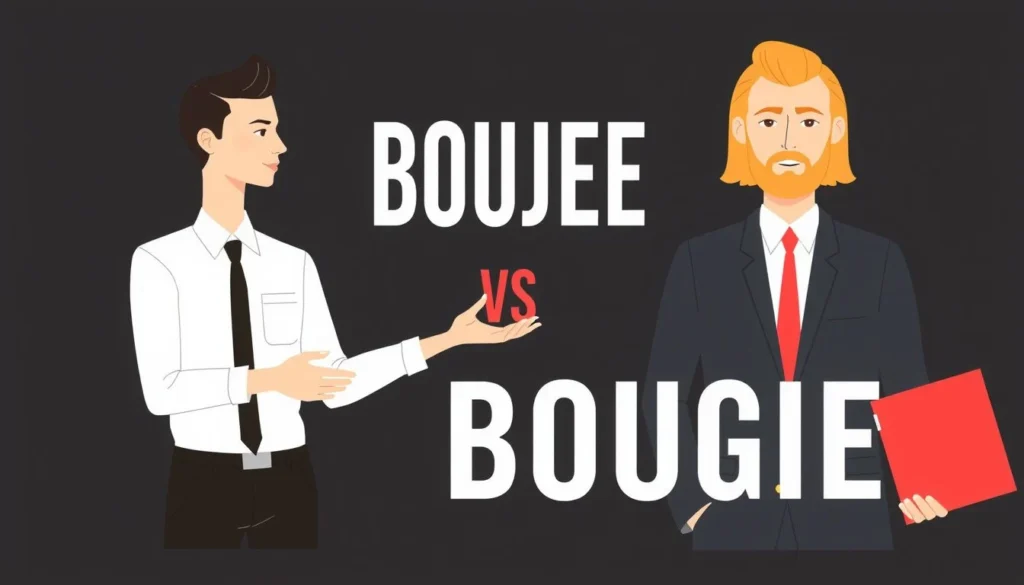
Boujee vs. Bougie: What’s the Difference?
You will see both spellings used online. They come from the same source, but they have slightly different connotations in modern usage.
| Aspect | Boujee | Bougie |
|---|---|---|
| Spelling origin | Phonetic respelling from hip-hop culture | Closer to the original French bourgeois |
| First mainstream use | 2016 Migos song “Bad and Boujee” | Used in Black American English since at least the 1960s |
| Connotation | Flashy, new-money luxury, aspirational | Pretentious, stuck-up, out of touch |
| Common usage | “That brunch spot is so boujee” | “She’s too bougie to eat fast food” |
| Tone | Often playful or admiring | Often critical or mocking |
The spelling “bougie” has a longer history in American English. It appeared in Black communities as early as the 1960s as a shortened form of bourgeois. It was used to describe Black people who were seen as acting white or looking down on their own community. The 1988 song “Bougie Natives” by the rap group Slick Rick and Doug E. Fresh is an early example in hip-hop.
“Boujee” with two e’s is a newer variant. It entered the mainstream in 2016 when the Atlanta rap trio Migos released “Bad and Boujee” featuring Lil Uzi Vert. The song hit number one on the Billboard Hot 100 in January 2017, and the word has been everywhere since.
How the Meaning Shifted in Hip-Hop
Hip-hop has a long tradition of reclaiming insults and turning them into badges of honor. The word “bad” itself is a perfect example. In standard English, bad means not good. In Black American English, bad has meant good, attractive, or impressive since at least the 1920s.
Boujee followed a similar path. A word that was once used to criticize people for being pretentious became a word people used to describe themselves with pride. Being boujee in a hip-hop context means you have made it. You have money, style, and access to things most people cannot afford.
The Migos song is instructive. The chorus goes “Raindrop, drop top, smokin’ on cookie in the hotbox.” The lyrics describe a lifestyle of expensive cars, designer fashion, and exclusive experiences. Calling yourself boujee in this context is not self-deprecating. It is a flex.
The phrase “bad and boujee” works because it combines two words that both flipped their meanings. Bad means attractive and desirable. Boujee means rich and stylish. Together they describe someone who is both physically appealing and financially successful.
This is a significant shift from the original French meaning. The bourgeois merchant in Molière’s play was mocked for wanting to be something he was not. The boujee rapper is celebrated for having exactly what he has.
Pro Tip: Context determines whether boujee is a compliment or an insult. If someone describes their own lifestyle as boujee, they are usually bragging. If someone describes another person as boujee, they might be criticizing that person for showing off.
The Class History Behind the Word
To understand the boujee meaning origin fully, you need to understand the class dynamics that shaped the word.
The bourgeoisie as a social class emerged in medieval Europe as towns grew and trade expanded. These were not nobles. They did not inherit land or titles. They earned their wealth through business. This made them both powerful and suspect.
Karl Marx made the term famous in his analysis of capitalism. In Marxist theory, the bourgeoisie is the class that owns the means of production: factories, land, capital. The proletariat is the class that sells its labor. Marx argued that the bourgeoisie exploits the proletariat, and that this conflict would eventually lead to revolution.
This political meaning still exists today. When someone says “bourgeois values” or “bourgeois morality,” they usually mean conventional, middle-class values like respectability, property ownership, and social conformity. It is rarely a compliment.
The slang term boujee carries echoes of this history. When you call something boujee, you are commenting on class. You are saying that this thing signals wealth or status, or that it is trying to. The word is a compressed class analysis.
Here is what boujee typically implies in modern usage:
- Expensive but not necessarily tasteful. A boujee restaurant might have gold-plated everything and mediocre food.
- Aspirational. Boujee things are often associated with people who have recently come into money, not old money.
- Instagrammable. A boujee experience is one that looks good in photos. The visual presentation matters more than the actual quality.
- Exclusive. Boujee implies access. VIP sections, private clubs, limited releases.
- Performative. Being boujee is partly about being seen being boujee.
Boujee in Popular Culture
The word has spread far beyond hip-hop. It now appears in restaurant reviews, fashion blogs, and everyday conversation.
Food culture has embraced the term enthusiastically. A “boujee brunch” typically means bottomless mimosas, avocado toast, and a long wait for a table. A “boujee grocery store” like Erewhon in Los Angeles sells $17 smoothies and has become a tourist destination in its own right. The word signals that you are paying for atmosphere and branding as much as for food.
Fashion uses boujee to describe designer logos, luxury streetwear, and the general aesthetic of looking expensive. Brands like Gucci, Louis Vuitton, and Balenciaga are frequently described as boujee, especially when worn in flashy, attention-grabbing ways.
The travel industry has picked up the term too. A “boujee hotel” means one with a rooftop pool, a spa, and a lobby designed for photos. A “boujee vacation” implies first-class flights, five-star resorts, and a carefully curated Instagram feed.
The word has even spawned derivatives. “Boujee on a budget” is a popular phrase for finding affordable ways to look or feel expensive. “Boujee-adjacent” describes things that are almost fancy but not quite there.
Is Boujee an Insult or a Compliment?
The answer depends on who is saying it and why.
When someone calls themselves boujee, it is almost always a form of self-congratulation. They are saying: I have good taste, I enjoy nice things, and I am not ashamed of it. This usage is common in social media captions and casual conversation.
When someone calls another person boujee, the intent is more ambiguous. It can be admiration: “She’s so boujee, I love her style.” It can be gentle teasing: “You’re too boujee for this diner, huh?” Or it can be genuine criticism: “He’s gotten so boujee since he got that promotion.”
The original negative meaning never fully disappeared. Boujee can still imply pretension, materialism, and a lack of authenticity. A person who is boujee in the negative sense cares more about appearances than substance. They are the modern equivalent of Molière’s bourgeois gentleman, trying hard to seem like something they are not.
The difference between the positive and negative meanings often comes down to whether the person is seen as having earned their status. Someone who worked their way up from poverty and now enjoys luxury is often celebrated as boujee in a positive way. Someone who was born wealthy and acts superior about it is more likely to be criticized as boujee in a negative way.
Pro Tip: If you are unsure whether to call someone boujee, consider your relationship and your tone. The word is casual and can easily be misread. Among close friends it is usually fine. In professional settings, it is best avoided.
Key Takeaways
- The boujee meaning origin traces back to the French word bourgeois, which originally meant “town dweller” and later became a term for the materialistic middle class.
- The spelling “bougie” has been used in Black American English since at least the 1960s, while “boujee” was popularized by the 2016 Migos song “Bad and Boujee.”
- In hip-hop culture, boujee was reclaimed as a positive term meaning rich, stylish, and successful.
- The word still carries class connotations and can be either a compliment or an insult depending on context and tone.
- Modern usage extends far beyond music, appearing in food, fashion, travel, and everyday conversation to describe anything luxurious or aspirational.
FAQ
Q: What does boujee mean?
A: Boujee means fancy, luxurious, or high-class, especially in a flashy or showy way. It comes from the French word bourgeois and was popularized in modern slang by the 2016 Migos song “Bad and Boujee.”
Q: Is boujee a real word?
A: Yes. Boujee is a slang term that has entered common usage and is recognized by dictionaries including Merriam-Webster and Oxford English Dictionary. It is a phonetic respelling of bougie, which itself is a shortened form of bourgeois.
Q: What is the difference between boujee and bougie?
A: Bougie is the older spelling and often has a more critical connotation, meaning pretentious or stuck-up. Boujee is a newer spelling popularized by hip-hop and often has a more positive or playful connotation, meaning rich and stylish. Both come from the same French root.
Q: Where did the word boujee come from?
A: Boujee comes from the French word bourgeois, which originally meant “town dweller” in medieval France. It evolved to mean the materialistic middle class, was shortened to bougie in American slang, and respelled as boujee in hip-hop culture.
Q: Did Migos invent the word boujee?
A: No. Migos popularized the spelling “boujee” with their 2016 hit “Bad and Boujee,” but the word bougie had been used in Black American English for decades before that. Migos did not invent the word, but they made the “boujee” spelling mainstream.
Q: Is boujee a compliment or an insult?
A: It can be either. When someone describes themselves as boujee, it is usually a compliment meaning they enjoy nice things. When someone describes another person as boujee, it can be admiration, teasing, or criticism depending on the tone and context.
Q: What does “bad and boujee” mean?
A: “Bad and boujee” is the title of a 2016 Migos song. In this context, “bad” means attractive or impressive in Black American slang, and “boujee” means rich and stylish. Together the phrase describes someone who is both physically appealing and financially successful.
Q: What is a boujee lifestyle?
A: A boujee lifestyle is one characterized by luxury, designer brands, expensive dining, exclusive experiences, and a focus on visual presentation. It often implies enjoying the finer things in life and not being shy about showing it.
Q: Is boujee the same as bourgeois?
A: Boujee is derived from bourgeois but has a different meaning in modern usage. Bourgeois traditionally refers to the middle class or to conventional, materialistic values. Boujee is slang for fancy, luxurious, or high-class, and can be used positively or negatively.
Q: How do you pronounce boujee?
A: Boujee is pronounced “BOO-jee,” with the first syllable rhyming with “too” and the second syllable sounding like the letter G. The original French word bourgeois is pronounced “boor-ZHWAH.”
References & Further Reading
- Merriam-Webster Dictionary: Bougie – Official dictionary entry with etymology and usage notes.
- Dictionary.com: Boujee – Detailed article on the slang term’s history and cultural context.
- Oxford English Dictionary Blog – The OED’s entry on bourgeois traces the word’s evolution from medieval French to modern English.
- Molière, Le Bourgeois Gentilhomme (1670) – The classic French comedy that satirized bourgeois pretensions, available through Encyclopaedia Britannica.
- Billboard: Migos’ “Bad and Boujee” Hits No. 1 – Billboard’s chart history documenting the song’s rise to number one on the Hot 100 in January 2017.
—
About This Article: This article was researched and written by a content strategist with a background in linguistics and cultural history. The etymological information draws on standard reference works including Merriam-Webster and the Oxford English Dictionary. The analysis of hip-hop usage is grounded in the documented history of Black American English and the commercial and cultural impact of the Migos song “Bad and Boujee.”